It was only in my 50th year that I found out, or perhaps recorded that I’d found out, that Nanna was born and bred at Pasture Farm, about a mile south of Swinefleet & Reedness. Extremely fertile farming land, high in silt content, the result of reclaimed marshland from the Aire & Humber. So it was, on a summer day in 2017, that I set out with my siblings Tricia, Mandy and Phil, along with my parents John & Moira, and brother-in-law Eric, on a trip down memory lane, or specifically a trip down John’s memory lane. And one of these lanes was Whins Gate, Swinefleet, on which sits Pasture Farm. Parking up outside the gate, we retraced the steps my father had taken many times before to the front door of the farmhouse where his mother had spent all her childhood life as a Blacker.
Was I just surprised or perhaps a little disappointed, that my grandmother’s house was a modest box shaped, pebble-dashed house with perhaps 3 bedrooms? I think I’d imagined something much grander, for no other reasons than what I’d read or deduced from statutory records. Only 3 years after Nanna’s birth, the 1901 census recorded what could easily be construed as a life of opulence and privilege, with 5 servants in addition to the 8 family members.
Joseph Blacker, Nanna’s father, was not just a farm labourer as many of England’s population are described at that time, but a farmer and an employer. With a family of 8, living together with 5 servants, I’d have expected a house of goodly proportions, possibly even grandeur. Perhaps that expectation was set by the address in the 1901 census – Swinefleet Grange.
The dictionary definition of Grange is a country house with farm buildings attached, but in my mind, Granges are only a step down from the Hall or Manor. So, when I saw Pasture Farm for the first time, I wondered what kind of a family life would be had with 13 people living in a house with 3 or possibly 4 bedrooms. There are outbuildings that still stand in the yard, I’ve seen those clearly when I’ve flown overhead in my microlight in one of my airborne trips down memory lane, so perhaps the servants lived outside of the main house, but 8 people in 4 bedrooms would still have been a squeeze, more akin to my own family life in Ilkley, with 8 modern-day Spences in 4 bedrooms. By no means hardship, but not the Grange-style of privilege than I’d imagined Nanna to have been brought up in.
I wondered whether at the turn of the century, the Blackers lived across the road at Reedness Grange, as the census would imply, and by 1911 had moved across the road to Pasture Farm, perhaps having built Pasture Farm on their vast lands. John & Bessie are not aware of that, believing Nanna to have been born and bred at Pasture Farm, and the ordnance survey map from 1907 and earlier in mid 1800s show clearly that Pasture Farm had existed on the same site for many years, so it seems likely that the 1901 census was merely mis-recorded as the Grange rather than Pasture House.
The Pasture Farm that we visited on our trip down memory lane is still in the family, owned by R Blacker & Son. However, less than a mile away is another Pasture Farm, 2500 acres operated by Farmcare, originally part of the Co-op Group, and owned by the Dawnay Estate, Viscountess Downe, one of John Spence’s old patients near Wykeham. This land was apparently bought in the 1920s from what was previously the Ousefleet Hall Estate and its 6 farms. Its slightly confusing why they call it Pasture Farm, but it seems that it is classed as Osefleet Pasture Farm whereas our family homestead is a little further to the west and could therefore be described as Swinefleet Pasture Farm. What is clear, is that the census takers also found it confusing!
Furthermore, Bessie is adamant that the house in front of which stands her brother John, is not the house her mother grew up in. The location described, directly opposite another farm (Moorend Farm) and turn left out the gate and walk to Blacker Siding on the railway line, are correct. On closer inspection of the zoomed in map, and comparison with the aerial photo above, it’s clear that the original house stood where the middle green barn now stands and with only 2 original “wings” forming an L shape surviving. The current house seems to have been built later, in place of a narrow barn. This was probably done after the war by Robert’s son Frank, who will have taken over the farm, and who won’t have needed space for 7 children plus servants!
Lillian Blacker left school at age 14 and helped at the farm, which grew potatoes, sugar beets, wheat, hay and barley. Generally, and in line with male & female stereotypes, which is how such things come to be so, the girls would help in the home with cleaning, cooking and mending, while the boys would help outside with harvesting, ploughing and other manual labours. And so it was with the Blacker family, a dynamic that preceded them for many generations. Groceries would be delivered from Swinefleet village by horse & cart each fortnight, including a large sack of flour and a block of salt. Potatoes would be plentiful from the farm.
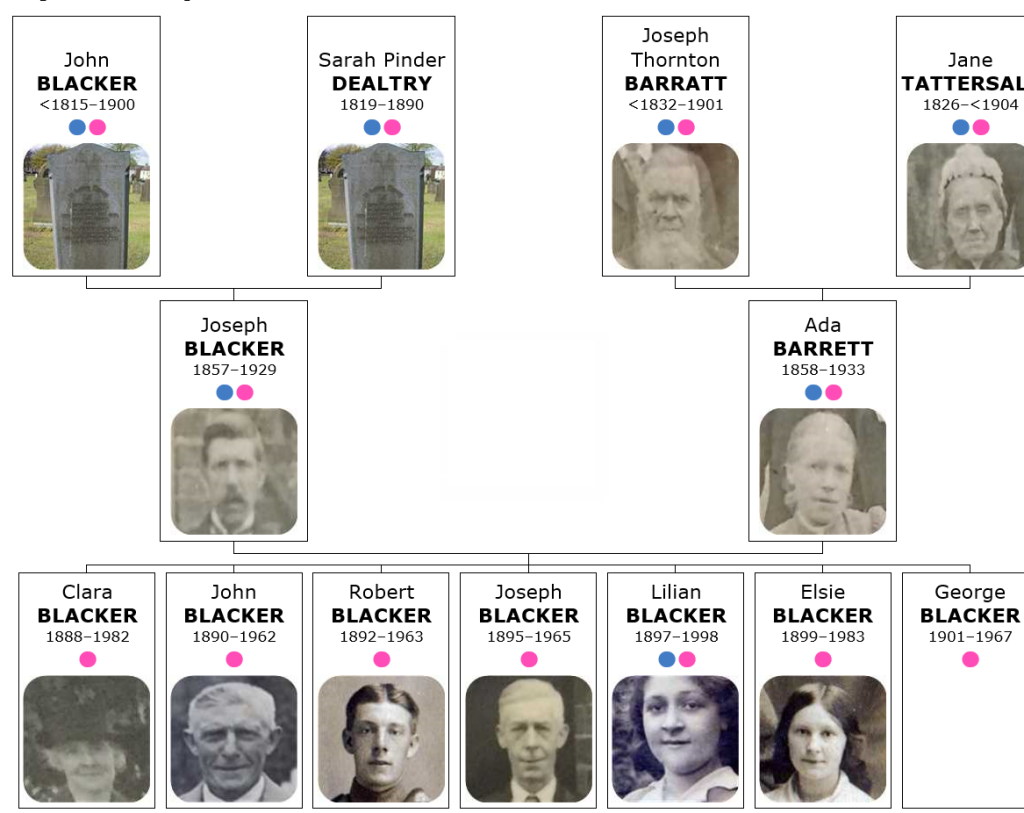
Lilian was one of 7 children born to Joseph Blacker and Ada Barrett, after their marriage, which took place on 5th April 1887, exactly 93 years to the day before my own sister Mandy was married. Not a great coincidence given the propensity for weddings to take place in the spring time, indeed my own was just 2 days later on 7 April. So it was on what could have been a fine spring day at St David’s Church in Airmyn that Joseph and Ada made their vows and embarked on their life together. Ada was the daughter of a Blacksmith from Airmyn (see The Barrett Family) and Joseph the son of the John & Sarah Blacker (see Blackers of Dobella Farm), farmers from Rawcliffe. Rawcliffe, Airmyn and Swinefleet are all within 6 miles of each so neither travelled far, a common practice for all the Blacker and Spence generations for the last few hundred years.
Joseph Blacker (1857-1929) & Ada Barrett (1858-1933)
As the marriage register shows, neither were that young, 29 and 28, and both were literate, having each signed their own names rather than received the often-used “X” in lieu of a signature for those not fortunate enough to have received a basic education.
Both Joseph and his father were farmers, as we’ve already learned, though I suspect at this point they would have been living and working John Blacker’s farm at Rawcliffe, rather than Pasture Farm in Swinefleet, which would perhaps have been acquired sometime between marriage in 1887 and Lillian’s birth in 1897.
The witnesses at the marriage ceremony, and perhaps the best man and bridesmaid, were both from Ada’s side of the family, her brother George, an agricultural blacksmith in Airmyn, and Mary Jane, only 20 at the time of Ada’s wedding, but later to marry herself to an Anderson.
The fact that Ada’s brother George Barrett was a blacksmith and Joseph Blacker was a farmer, was no surprise as their fathers both has the same occupations as their sons. This was very much the norm in those days, where sons learned the trades of their fathers and passed them down the line. We can see the same patterns across all the family lines in our history.
I’ve traced the Barrett family back several generations, and like many in the Yorkshire side of the family, they didn’t travel far, a different county, Lincolnshire, but not more than 20 miles from Airmyn. That said, their Winteringham origin is a good 40 minutes drive nowerdays with no easy way to cross the Humber or Trent, but perhaps their mode of transport back then was down the river or canal network.
One wonders why Joseph Blacker didn’t have one of his 4 siblings as a witness at his wedding which was the more common way, one witness from each side of the family. Perhaps that it was at Ada’s local church that explains it, or perhaps that Joseph’s siblings were all older and had children of their own to attend to, so would no doubt be occupied with this during the service.
Joseph & Ada’s family
Married less than a year, Ada became pregnant and gave birth to Clara in December 1888. Clara was baptised a month later in Rawcliffe, so it seems likely that Joseph and Ada lived with Joseph’s parents at Dobella farm in the first year or two of marriage. By the birth of their second child John in 1890, the family had moved along the river, within 2 or 3 miles of Pasture farm, to the village of Whitgift, where John was baptised, exactly a year to the day after Clara’s baptism – I imagine there was some sentimental discussion on choosing the same 4 January day the second time around. At Whitgift, Joseph was a tenant farmer, renting Church Hall Farm from a James Robinson. Note that the Blacker family’s neighbour was a Barrett, though not one of Ada’s siblings.
By Robert’s birth and baptism a year later in 1892, the family were noted as coming from Reedness Common, which may well be synonymous with Swinefleet common, as they tend to be used interchangeably, so it’s likely that the family moved to Pasture Farm, Swinefleet common, in or around 1892. In fact, on Joseph’s baptism record in 1895, he was noted as being from Reedness Swinefleet Common.
So, when my grandmother, Lilian Blacker, was born in 1997, the family had lived in Pasture farm for a couple of years and made it their home, not radically different from the house we visited in 2017.
In addition to Lilian’s 4 elder siblings, she had 2 younger ones, Elsie & George, bringing the tally for the family to 3 girls and 4 boys – you can read more about them later.
Joseph and Ada passed on Pasture House farm to their eldest son Robert in the 1920s and moved to a new housing estate being built next to Couper Street in Goole, where their daughter Lillian Blacker, my grandmother, had also moved. In fact, Lillian’s father-in-law, John Spence, bought 4 of the first 8 houses on the new Morley Street and Joseph & Ada bought the other 4. Lillian and her husband, John Spence, moved into number 2 and Joseph & Ada moved into number 4.
Joseph didn’t live long after moving to the new house, age 71, leaving Ada to live on there for another 4 years. Her son, Joseph, registered the death, the cause of which was ovarian cancer.
I’ve visited the grave of Joseph & Ada a number of times, towards the back of the church in Swinefleet churchyard.
Clara Blacker & George (Harry) Cowling
Eldest sister Clara married George Henry Cowling (commonly known as Harry), one of 8 children of Maurice & Ann who lived and worked one of the neighbouring 26 acre farms in Reedness. They married a few months before the outbreak of the Great War in 1914, which they fortunately survived allowing them to build their family of 6 children – Vernon, Mary, David, Kathleen, Vernon, Eric and Mona. In 1939 census they were living at Ivy House Farm in Reedness.
Harry Cowling was in the forefront of agricultural life as he had the first Dutch Barn in Reedness which meant that the corn harvest could be stacked there with no need for thatching. They were also one of the only families at that time to own a car in Reedness, and one of the first to install electricity in their house in 1941.
The old Ivy House farm, with its kitchen extension at the back, has been demolished now and replaced with another house, but the photo to the right is the original. A local village story about the Cowlings is that during a thunderstorm, with their front door open, a green ball of lightening came through the front door, shot past the dining table, to the stove and up the chimney, a phenomenon that is only heard of every 50 years or so!
Harry Cowling had a deep booming voice and would visit John & Moira when Susan Spence was a young child, bouncing her on his knee singing “the Cows go Moo and the Sheep go Baa…”.
Uncle Vernon (his middle name, his first name was Fred) was the eldest, born in 1915. He married Enid Butler, Auntie Enid, who I remember visiting Nanna on occasion. They lived at The Paddock in Reedness.
Kathleen Cowling married Eric Dixon from Whitgift. She was the first bride to be married in the Methodist chapel in Reedness. Before that, it had never been used for marriages and her father paid the licence fee for it, so she was the first. Kathleen & Eric had 2 children, Janet & Beryl.
David Cowling never married nor had children. A lovely man, soft in nature, he’d occasionally visit John & Moira, often bearing gifts of tea pots or similar family heirlooms, with the whispered request “don’t tell my sisters!”.
At the Blacker reunion that John, Moira, Eric, Mandy and I attended by invitation from Christine Blacker in 2018, Eric & Mandy sat next to David, who at the age of 89 years was in fine health, bright as a button and demonstrating great knowledge of our family history. Sadly, David passed away in March 2020 at the start of the Covid pandamic, and my intentions to pick his brains were thwarted by my procrastination.
Mary Cowling was David’s twin sister. Twins in Reedness were a rarity at that time, and the family were often known as the family with the twins. Mary did marry, Geoffrey Featherstone, whom I have no information nor photos. Sadly, Mary also passed away around the same time as her twin brother.
Eric Cowling, born in 1920, married Muriel Cattle in 1950, nothing more known at this point.
Finally, Mona Cowling, who died in 2018, married Arthur Milner in 1940.
John Blacker, Florence Scott & Margaret Bramhill
John Blacker was Nanna Spence’s eldest brother, born in 1890, and married age 25, less than 1 year after sister Clara’s wedding, to Florence Scott from Howden.
They were married at St Margaret’s church in Swinefleet in 1915, their first child Harold being born before the end of that year, followed 2 years later in 1917 by their second son Arthur. Sadly, Florence contracted influenza, and died on 9 May 1920, aged 29, from pneumonia. The biggest cause of death at the time was, of course, the Spanish Flu, and perhaps this was therefore the underlying cause. The photos show Florence and her 2 children shortly before her death.
Lillian, John Blacker’s sister, recalled having Arthur to stay at Pasture Farm, after the death of his mother. Playing out with the animals on the farm, Arthur was kicked in his head by a horse and suffered a serious head injury, which apparently left him with some learning difficulties in later life.
Both Arthur & Harold played an active part in 2nd world war as part of the Home Guard, and both lived to a ripe old age.
Both Arthur and Harold remained unmarried, although Harold had a very closer relationship with his housekeeper, Annie Simpson and they are buried together in Wressle cemetery.
Fortunately for John, men were in short supply following the end of WW1, and it didn’t take him long to find love again, marrying Margaret Bramhill the following summer in 1921. Margaret was one of 4 children of Luther Bramhill, another Reedness family. The first of their 8 children together was born just 6 months after their wedding and only 18 months after the death of his first wife. Clearly a man who didn’t hang about!
Uncle John and Auntie Maggie, as John Spence remembers them, had over 40 years of marriage and 8 children together, the eldest of which, Clifford, took over the family home prior to John’s death in 1962, John and Maggie moving to a bungalow in Wressle for their last years together.
The original family home passed down to Clifford was Loftsome Bridge Farm, bought by John & Maggie in 1931. It’s now a large hotel close to Wressle on the Yorkshire/Lincolnshire border.
We visited Loftsome Bridge on our 2017 Trip Down Memory Lane, walked to the river Derwent where John Spence remembers a boat breaking over the riverbank into the field adjacent to the house during a flood; identifying the place where an old photo of Luther Bramhill and Mavis Blacker was taken; Looking across the fields where John Spence would shoot rabbits and narrowly missed being shot by his cousin; finding the pond where John used to go fishing; visiting the inside of the house, now a hotel and hearing about the glass cabinet that used to contain a stuffed fox and similar creatures; and watching our own Eric Welburn tumble down an embankment whilst trying to get to the famous Loftsome Bridge, the history of which dates back to the Doomsday book when the lands were owned by the Percy Family from the castle in Wressle.
Bessie recalls all the Blacker families meeting up for Christmas at Loftsome each year and having a thoroughly enjoyable time.
Even after passing on the family home to Clifford, John Blacker passed on a sizeable estate to Maggie, over £10,000 in 1962.
In 1949, Clifford married his wife Doreen, a Jarrold from Howden, who at time of writing (2020) is still alive and lives in Wressle. Prior to that, they moved from Loftsome Bridge, clearly too large for their needs as I don’t think they had any children, to a new house in Newsholme, a hamlet near Howden.
With some sentiment, they named their new house Loftsome House. Bessie recalls visiting the house and Clifford, who’d designed the house himself with a very clever layout, showed her round proudly – it even had a “gun room”!
I have photos of the rest of the John Blacker family below. The youngest son, Ernest Blacker, married Joyce Watson in 1948 and they had 3 daughters, one of whom, Christine Blacker contacted me in about 2015 having spotted my research on one of the genealogy websites. We shared information and photographs and I had dinner with her and her husband (who sadly passed away in 2019) at their home in Netherton, 1/2 mile from Blacker Lane, and less than 2 miles from Blacker Hall Farm, one of the first Blacker homes dating from the Doomsday Book.
It was Christine, together with Andrew Pearson, son of Mary Blacker, who arranged the Blacker reunion which John, Moira, Mandy, Eric & I attended in 2017, having dinner with this branch of the family including John Spence’s cousins Mary Blacker, Mavis Blacker and David Cowling, all in an around their 90s.
Robert (Bobbie) Blacker & Frances Picksley
The 3rd child of Joseph & Ada Blacker was Robert, or Uncle Bobbie as John Spence knew him. Robert left home age 23 and joined the Royal Artillery regiment in 1916, travelling to sign up in Newcastle. Surviving the war, he married Frances Picksley in 1920 and started their family the following year – 3 children, Frank, Dennis and Margaret.
Robert was described in census returns and in his military papers as a horseman, though general agricultural worker or farmer would also capture it. When Joseph & Ada Blacker died, in 1929 and 1933 respectively, Pasture Farm had already been passed down to the next generation. By traditional rights, it would have been passed to the eldest son, John, but as we know, John bought the farm at Loftsome Bridge. It’s not yet clear whether this was before, after, or at the same time that Pasture Farm was handed on, but it was passed to Robert, the second eldest, rather than John.
Unlike Uncle Robert from the previous generation (Joseph Blacker’s brother, sometimes mistakenly referred to as Bobbie), this Bobbie didn’t drink alcohol, though he did like a smoke – rolled his own from a tin of tobacco. Lillian (Nanna) had a special soft spot for her brother Bobbie, and talked about him with great affection. My father John Spence also remembers his Uncle Bobbie with affection, having had bike rides together and also riding on his horse & cart.
Cycling was clearly a big thing for Bobbie, as Bessie remembers Uncle Bobbie arriving one day at their house in Goole, having cycled from Pasture farm, with news that Grandpa Picksley was very ill and that Frances was looking after him.
No news followed for a week, and with no telephone or internet, the Spence family feared the worst. The following week Uncle Bobbie returned on his bicycle bearing bad news – “Grandma Picksley has died”. Everyone thought they’d misheard, but sure enough, Frances’s mother had died unexpectedly, not the father. Sadly, it became doubly bad news as Grandpa promptly followed Grandma a couple of days later!
But Robert was not all squeaky clean – in 1948 he was fined 10 shillings for keeping dogs without a license. Then again, he was in good company, as the vicar of Goole was also fined at the same hearing!
John Spence also talks fondly of Florence Parrott, an older and much taller girl who used to play with him and Bessie as kids. Mr Parrott was a salesman, who owned a car and would drive round prospective customers with a boot full of pots and pans, showing off his wares and taking orders for later delivery. John remembers accompanying Mr Parrott on these trips on several occasions and having a fond spot for him and his daughter. It’s not clear, but perhaps this was the link that resulted in Florence meeting John’s cousin Dennis Blacker and marrying her in 1949. The couple moved to Park Farm in Acaster Malbis, just south of York, where even to this day, the Dennis & Florence Blacker descendants continue to farm. Sadly Florence died as a result of cancer at the age of only 51 and Dennis only 5 years later at the age of 57.
Robert has 2 other children, Frank and Margaret. Both married, Margaret twice. I can find no record of Margaret’s death, and at age 95, its possible she is still alive at time of writing. Frank is likely the one who inherited Pasture Farm from Robert, and I’m guessing his eldest is the R Blacker that lives there now.
On our family Trip Down Memory Lane in 2017, we visited Ada & Joseph Blacker’s grave at Swinefleet cemetery, and whilst there, stumbled across the grave of Robert & Frances, only a few yards from Robert’s parents.
Joseph Blacker & Ida Ellis
Joseph was the next eldest above Nanna, born in 1895.
I was pleased to find, in my research, a photograph of the class of 1902 – a Swinefleet school photograph, labelled up with many of the school children’s names, top left of which was our very own Joseph Blacker. There’s an easy comparison to be made further below with the Joe from 50 years later at his daughter’s wedding.
Home for family remained Swinefleet, initially at 72 King’s Causeway (referred to as 72 Council Houses, Swinefleet on the death register of Ada, Joseph’s mother), and then round the corner at 19 High Street. Jobwise, he was noted on the census as a tractor driver, so presumably he worked on one of the family farms rather than working his own farm.
Joseph married Ida Ellis in 1925 and together they had 3 children starting the following year – Brenda, Granville and Valerie.
All of the family are on the photo below from Valerie’s wedding in 1954. Interestingly, none of the Blacker cousins, aunts, uncles or grandparents are on the photo, and they are certainly a lesser-known part of the Blacker family as far as our Spence branch was concerned.
Joseph’s claim to fame was climbing a tree to saw off a branch, sitting on the branch and sawing the wrong end! He fell breaking his ribs – he never recovered fully and suffered ill health for much of his later life, dying in hospital aged 70. That’s one version of the story. The other is that he fell off the back of his tractor and broke his leg. Of course, they could both be correct.
Lilian Blacker & John Spence
Lillian & John are my paternal Grandparents. To read about them and their family, read the section on The Spences of Morley Street, Goole.
Elsie Blacker & Roland Oxenforth
Elsie was born 2 years after Lilian in 1899, and I expect had a similar early life, although in the 1911 census, at age 12, she was still at school whereas Lilian had already left and was helping around the home.
Elsie married Roland Oxenforth in 1924. Roland was a painter and decorator from Crowle, whose father was also a painter and decorator. Crowle was only a stones throw south of Swinefleet and the wedding was at the Parish church in Swinefleet.
Uncle Roland and Aunty Elsie were frequent visitors to Nanna’s house and I have vague recollections of Roland as a kind man.
I’ve also had correspondence with other people researching their family histories in the area, and Roland’s is a name that has been mentioned with affection.
A year later, their son Gordon was born. He was to be their only child, and sadly he died aged 5.
George Blacker & Mary Bullass
George was the youngest of the Blackers, and like the rest, he was a farmer. Leaving home and marrying Mary Bullass from down the road in Whitgift, in 1923, aged 22.
One family story, perhaps true, perhaps not, is that George fell in love with a girl who Joseph & Ada deemed unsuitable for the hand of their youngest son. In order to address the issue, they paid a very large sum of money to her parents (£5000 has been mentioned, though this would equate to £300,000 in today’s money so perhaps it was ‘only’ £500).
Apparently, the money was accepted, but the couple ran off and married anyway! And in time, the Blackers came to realise that she a “good wife” after all and they’d made a costly mistake.
Mary’s parents were Thornton & Elizabeth Bullass, and her grandparents were Thompson & Eliza Bullass of Thornton House in Reedness, and from all accounts were upstanding residents. In addition, the marriage register shows both parents witnessing the ceremony in the Parish Church at Whitgift, which does not tally with the story.
Neither George nor Joseph were talked about much in our branch of the family, so perhaps this story related to Joseph rather than George, and was mixed over time. This is more likely, as I can find no parish marriage register for Joseph’s wedding, and his wife was ‘out of area’, daughter of a bricklayer from a colliery, John Ellis, originally from Leeds and later from Pontefract.
From birth registers, it looks as though George & Mary had 12 children together, although by the 1939 census there were only 6 children living in the same household. It’s possible that some of the 12 died in infancy, and it’s also possible that some had already left home by 1939.
5 of the 6 children in the house in 1939 appear to still be alive, as a result of which their names and details are blanked out from the census. It will likely be some years therefore before the names are released – in the meantime, let’s just say George & Mary had a large family.
The good news is that they also had a large house to bring them up in. Most of their married and family life was based in Rawcliffe, at South Farm on New Lane. According to Zoopla, the farmhouse has 5 bedrooms, 4 reception rooms and 2 bathrooms.
It’s also still in the family, apparently owned by R+P Blacker.
George died in 1967, Mary in 1979.