Eric Wallace and Lilian Anita Fisher
Eric’s Younger Years
How better to start Eric’s story than to hear from Eric himself?! In the years after he died in 2018, I catalogued and scanned many of the photos, keepsakes and documents he and Anita had kept in their memories trunk over the decades they were together. One of these documents was a handwritten manuscript entitled “A Life, Chapter 1”. This tells the story of Eric’s early years, mainly describing his memories of everyday life at their home on Yelverton Road. I’ve transcribed it below, and added a few relevant photographs.
A Life, Chapter 1
I was born on the 17th May 1931 at 86 Yelverton Road, Anfield, Liverpool 4 at some time which I do not remember.
I was the last child. I had three brothers – Donald (who had died when he was about five of some illness), Kenneth (born c1923) and Wilfred (born c1929). My two sisters are Hilda (born 17th May 1925, and so exactly six years older than me), and Edith (born c1929).
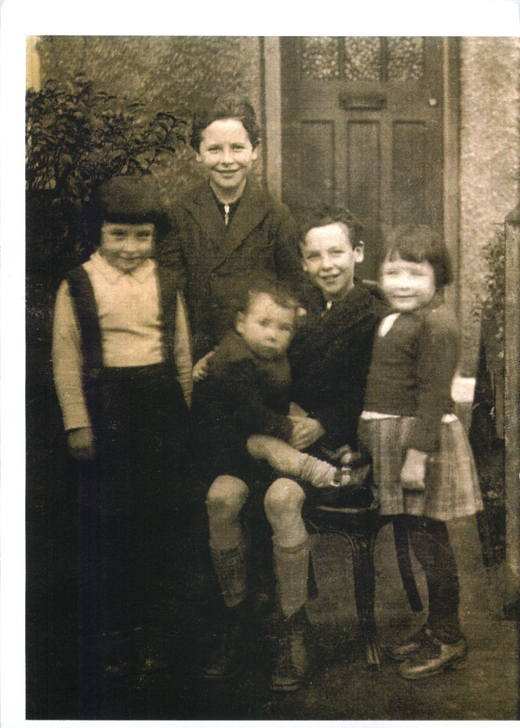
My father, William Arthur Wallace, and my mother (nee Catherine Charnock) were probably in their early forties when I was born. They seemed happy enough as a couple, although my mother was almost certainly the dominant one. She had worked as a tram conductress until she was married, and then devoted herself entirely to bringing up her family. My father was a marble polisher and worked just as an ordinary working man – even though he had brothers with their own business. My mother looked down on this job and kept insisting that he could have got a “better” (ie clerical) job if he had really wanted. This surfaced later in another form, when she claimed that Wilf had deliberately failed the scholarship examination – I’m not sure why.
The house we lived in was, of course, a rented council house. My father was probably out of work when I was born so naturally, we had no telephone. Or central heating (virtually unheard of then), or car or refrigerator. But there were advantages. The council, as landlord, regularly sent a gang of decorators round, and they would do a street at a time. The street consisted mainly of terraced houses, with entries at intervals, but our house was actually the second one along of a pair of “semis”. It was a good solid three-bedroomed house with a longish kitchen (red tile floor), a hall, sitting room (or front room), bathroom upstairs and toilet in a porch off the kitchen- not quite “outside”. We used to call the kitchen “the back kitchen” so perhaps we used to call the front room “the kitchen”. I forget.
All cooking and eating was done in the back kitchen where there was a big, heavy, substantial table. In the corner was a coffee boiler heated by a gas flame underneath for the clothes washing (no washing machine of course). To go with this were two Dolly tubs – large metal tubs with corrugated sides. The washing would be boiled up in the boiler and then transferred (using a wooden stick I think – memories come back of pushing a stick in the boiler and twisting it, So that the clothes folded around it) to one of the tubs. There it would be thoroughly churned around using the Dolly pegs (which can still be found as Curiosity ‘s in antique shops!) In the second tub would be cold rinsing water in which the “blue” had been put. Also at that end of the (back) kitchen was a marvellously solid mangle. The clothes would be squeezed out and then hung on a clothesline which run the full length of the back garden. They were pegged along this, and then the line would be hoisted in the air using a clothes prop (ie A long pole with a V cut in one end in which the line sat). In the summer, when it was very fine, some clothes would simply lie on the walls to dry.
The yard immediately outside the back kitchen was rectangular. Along one short end adjoining the first semi was the coal shed – we burnt cold downstairs. But upstairs there were a number of gas fires with very little white elements. We could rarely afford to use these. The coal (from the Co-op) was delivered by horse and cart. The horse brings back memories of going out with bucket and shovel to collect the manure – with water added it was splendid for the garden. The cart reminds me of rides when nearly all the coal had been delivered. We very rarely saw cars in our street, but the real fascination was when the street drains were emptied. The lorry would come and put a long pipe down the grid to suck out all the muck. Then water would be flushed down it. Because of the lack of cars, we were able to play out in the street without any fear. Football, of course, which I probably avoided. But skipping rope stretched across the road, with several children skipping on it at once. The lamp posts in those days were not very high and had two arms just below the light. So a rope would be tide to an arm and we would swing around the lamp. Wonderful, unless you went too fast and banged your head on it. Marbles, or “ollies” as we called them then, were much in evidence – In summer when it was very hot, the tar on the roads would bubble up and it was a routine to go along bursting these bubbles. When all is run out, we use caps of bottles. Both my parents smoked, although my mother only started during the war after persuasion from my brothers and sisters, and cigarette cards were in most of the packs. These cards would be set up against a wall and the aim was to knock them down by flicking other cards at them. When I think of the value of these old cards now!
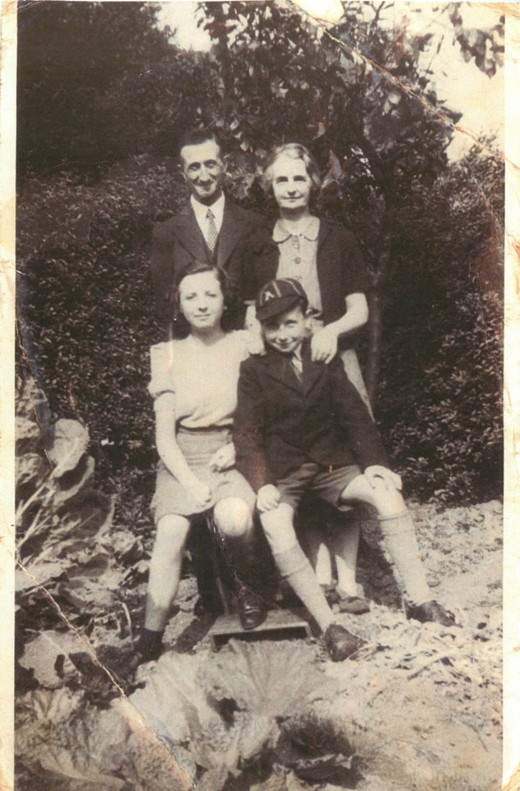
To get back to the backyard – as the yard was called. On the other long edge was a small shed containing our bikes and gardening tools. Even though the garden had a reasonable amount of grass, this was always cut with shears. I think we may have acquired a lawnmower just before I left there. It is one of the most tedious and sometimes dangerous jobs, cutting along with shears. When I was about four, I was playing in the garden when Wilf was cutting the grass – I nearly lost the end of my left thumb. The nail saved it, but a long scar is still visible. The various gardens were mainly bounded by private hedges, which really provided us with a lot of privacy. Although most of the garden was grassed over, there was a flower border edge in it, and in the middle a rhubarb patch and a patch of garden mint. At the bottom of the garden was an apple tree and a plum tree which never bore fruit. Except once when a small plum appeared. Every Saturday, our dinner (at midday, we never had “lunch”) consisted of roast beef or lamb, boiled or roast potatoes, fresh vegetables, gravy and a rice pudding (homemade, not tinned rubbish) to follow. When we had lamb, my job was to fetch in some fresh mint, chop it on a board with a black handled large knife, and prepare the mint sauce (never Jelly) made by adding vinegar and a little sugar. With so many it was necessary to have the rice pudding in two bowls, a main one and a small one for one person. It was my desire to have the small one, which I usually managed. My other wish was to have the knuckle off the lamb. The potatoes and vegetables were so fresh that we drank the water in which they were boiled – it was held that this was very good for me, and it was actually very tasty. Immediately a meal was finished my mother would start clearing away and washing up. Eventually she would start doing this before we had finished, and often had almost to be forcibly sat down again! The sink with a large wooden draining board was next to the boiler, and we could look out of the window on to the back garden. For economy (particularly when the war came) we had a small metal cylinder, with lots of small holes, on a handle, and some bits of soap were put in this for reuse, or rather to use up. Next to the draining board came a small wooden safe (for food – our money was not worth hiding!) with a fine mesh on half the door. No refrigerator, so food was more or less bought daily if it was likely to go off quickly. So daily shopping was a regular routine. Finally, along the wall came the electric cooker, with a big mains fire box above it, and then the back door opening into a little porch, and then out to the yard. I think there was a ladder on the other wall, but my memory fails me on this. The other long wall opposite the window had the long kitchen table alongside it. On the second wall, quite high up, was the hot water tank. The water was heated by a back boiler behind the coal fire in the front room. So if it was hot weather and you wanted hot water, then you had to suffer a fire. One bath would take all the hot water so it was no use being in a hurry. Eventually we may finally have got an immersion heater, but that would not have been for many years.
Incidentally, our rent for the house included the rates and it was collected weekly. When the rent was about to be increased, we would effectively be given notice to quit, but would be allowed to remain if we paid the higher rent.
I can remember I had a bike starting with the three-wheeler. I can remember coming off this in the street and almost tearing off my right thumbnail. I was rushed to hospital where it was all neatly bandaged up including the damaged nail. Eventually this came away and a new nail grew. Quite a thumb! I grazed my knee too in this incident (I think it was this one), and purplish scar still remains. This reminds me that my mother must also have worked at sewing for a time, because she lost the end of a finger in some sewing accident.
A third regular delivery at the home (coal and milk being the first two) was a newspaper (Daily Express and Liverpool Echo). When I was only about four or five I used to help the paper boy – just for the fun of it. He called me “smiler”, so I must have been very happy!
My only really major illness occurred at this time. Few days before Bonfire Night in 1936, when I was five, I became quite poorly. On Bonfire Night I could hardly swallow, and in desperation the doctor was called. A large, pleasant man, Doctor Styles. He was almost certain it was diphtheria, but to make sure he took a swab to be sent off for examination. However, he reckoned I was in great danger of dying if he simply waited for the result. So it was decided to send me immediately to the fever hospital. Probably Alder Hey? I can remember asking my mother why there was so much noise, from the fireworks, and couldn’t be told to be quiet. I was in hospital for two months. Right over Christmas. I was. I have no idea what medicines I was getting, but a very simple system was used for telling when I was recovered. Each day a swab was taken and if the result was positive then I was still ill. When I could get three consecutive negative results, then I could come home. The rejoicing when that happened! Certainly in the early stages I could only see visitors through a window. But later there were non-family visitors who used to come and talk to us and read us stories. That was very enjoyable. Out of all this time, only two incidents really stuck in my mind. Clearly I was confined to bed, at least to start with. One day or evening, I was sitting on the ”poe” in bed and was so relaxed that I fell asleep. I can remember being woken up by the nurse as I was sitting there quite contentedly. Then there was my coming home. All the immediate neighbours and friends and relatives came for this Second Christmas, as none of the presents could be taken into the hospital. It was permitted to have a good party, even if money was quite short.
Memories of the “poe” bring back a little rhyme:
“Everywhere I go, I carry my poe, and a little bit of last night’s Echo!”
Perhaps I should mention that these were in regular use by everyone, so every morning they had to be emptied. Eventually a seal would be developed and so this had to be chipped away at regular intervals. I suppose we didn’t go down to the WC because it would have meant unlocking the back door and it would have been very, very cold in winter.
Particularly in winter, the house would be very cold in the mornings before the fire was lit. So ice would be on the window frames, creating beautiful patterns. But the lying on the floor would be terribly cold. So it was a common practise to get dressed as much as possible while staying on, or even in, bed.
In a sense, life was much more formal then. All the adult neighbours addressed each other as Mr and Mrs and I used to get very irritated when our next door neighbour in the first house used to knock on the wall to attract our attention. Why can’t they come to the front door and knock? This question of knocking often used to make me wonder if I had missed the chance of winning a prize. Our front door had a large brass letterbox and this was regularly polished every week. To avoid the polish going on the door, we would fit a piece of temporary cardboard around it. Going to the cinema was a much more regular happening then as there was no TV of course. On one occasion it was announced that Mrs X had won a prize for her idea of…” Putting a piece of cardboard around the letterbox!”. I really felt quite annoyed. There was much more brass in everyday use then. The stairs carpet was held down by brass stair rods. Big heavy ones which were regularly taken up and polished. I can still feel and visualise the process of fitting them back into the clips at each end of the stairs. Every morning before going to work, my father would rake out the ashes of the fire and set or light the new one. Here also brass tools were in regular use. They would be treated as antiques now! Thinking of the stairs again, one had to be very careful when the rods were up not to fall down stairs as the carpet was very loose. Another regular job was using a white stone to make the stone front doorstep white. We even had a window cleaner who came every week. A very talkative man, so one kept clear of him if you were in a hurry.
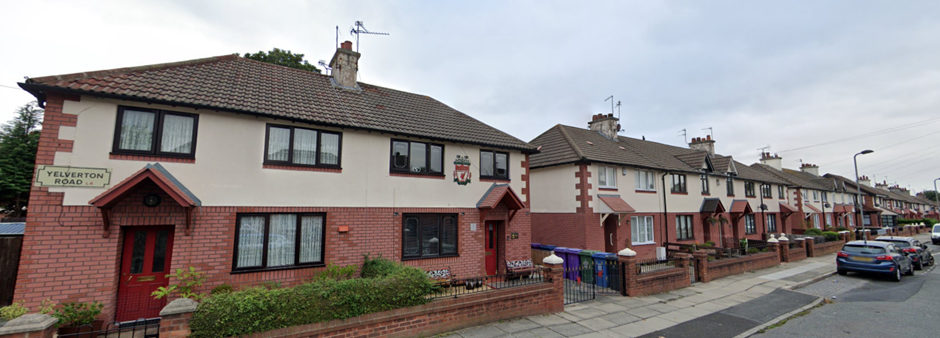
At the front of the house was a short path leading from a small wooden gate to the front door. On either side of this path was a small front garden with its piece of grass a small square. And necessary private hedges. All these, remember, being cut by sheers only. We had two or three different neighbours in the adjoining semi, but in the first of the terrace block on the other side lived Mrs Roberts with her parents. Her husband was a merchant seaman who later became a Docker. He eventually died quite old of cancer of the throat. They had moved from “Scottie Rd” (ie Scotland Rd). This was the very poor, rough main road near the centre of Liverpool which claimed to have a pub on every corner. At least. Probably more. Mrs Roberts was determined to shed the image of her previous address and spent most of her life in keeping her house absolutely spotless. Anyone who went in, including Mr. Roberts, who was a large, pleasant, rather gruff man, had to take off their shoes. I think even sitting on the chairs was almost frowned on in case they were dirtied. Nevertheless, Mrs Roberts, notice the formality, was a kind, friendly person, but I guess not too many people ventured in. If they were away, we would mind the parrot. Polly, of course. And I seemed to be the only one it would stand. Anyone else’s fingers near the bars of its large round smelly cage would get a sharp beak viciously scoffing. But I could even put my fingers in its mouth. I’m not sure I would do that again.
We ourselves only ever had a canary and a budgie as pets, never a cat, dog or a rabbit. Eventually the canary, rather small and pathetic, became bald and died. The budgie, which never said very much if anything, eventually died during the war. We found it lying on its back one morning, perhaps a violent raid had given it a heart attack.
In the first house, opposite lived Mr and Mrs. Cotton, their daughter Dorothy and two sons, Sidney and Harry. Really quite a tragic family. Dorothy married and had a baby with water on the brain. A boy, I think. She used faithfully to push him around in his pram. Howard eventually got entangled with an older woman, a widow, and confessed to his mother one day that he had swallowed a large number of tablets, and wished now that he hadn’t done. He was rushed to hospital but it was too late. Sidney married and left home at some point.
Next door to them lived the Latimers. Father worked for a big grocery firm as a manager but seemed to be away a great deal. Mrs L had a reputation for not paying bills and it was well known that she would often be in the house, but not often the door to tradesmen wanting payment. They had a daughter, and when I was about five I went to a party there. I couldn’t understand why my parents were upset up by winning a prize for eating the longest! A little bit further down on that side of the road was Hareham Rd. Life was very local and I don’t think we knew anyone on the other side beyond that road. When I row inside, there was a family of O’Connors next to the Roberts. There were two daughters, Eileen and Maureen. Eileen was fat and to most people plain whereas Maureen was quite pretty. Much to everyone’s surprise, Eileen was courted and married and had a family. It seemed at that time a perfect example of “beauty is in the eye of the beholder”. Further down the road, two families only spring to mind. The Anderson’s had a violent father, and very often the wife and one or two of the young children would remain in the street outside the house until the older one came home to protect them. Also, living down that end, it really could have been another country, lived a young woman with a wooden leg. She’d been injured in an accident and we could hear her clip clipping up the road. She was always very pleasant, but I don’t know what became of her. Oh, and we did have cancer in those days, although it didn’t seem to be talked about and discussed as much as now. Opposite, just below, the Latimers lived Mrs Green, who died very painfully, we were led to understand, of cancer.
On the opposite corner, next to the Cottons, so that their front door was really in another road, lived a family called the Marshalls. They had a big, pleasant, shaggy dog called Barney. We certainly A few families just round the corner, but I remember very little about them. It is a case of one or two people standing out. Beyond our back garden, I remember were two particular houses. It one lived a man who’d had his own small radio repair business. In retirement, he used to sit out to watch the sun at every possible opportunity, just wearing a pair of shorts. So he became very brown. In the other house left a family who insisted on leaving the windows open and playing the radio as loud as possible. I believe the police used to be called eventually.
With us at this time, until I was about four, we had one of my grandparents, probably my mother’s mother. She was very old, in her 80s I think, certainly for those days, and had one of the bedrooms where she stayed most of the time. She was very cantankerous and used to bang on the floor with her stick when she wanted something. I remember once getting so upset by her that I threw a hair brush at her. She must have died in the home and been buried from there, much more usual than cremation, but I can’t recall a funeral at all.
I was an extremely shy child, although very happy. As is often the case with shy people, I imagined that I was the centre of attention. So for a long time into my teens, I was painfully embarrassed of any strange people. Girlfriends or boyfriends of the rest of the family who came to the home. When I was still very young, it was not unknown for me to go and hide under the stairs. Over the years I have had to fight this, but deep down it is still there.
Unfortunately, that’s as much as Eric wrote. We know he’d intended more, as this was headed Chapter 1, but the remaining chapters remain elusive. I’ll therefore try and fill in the gaps.
Eric attended Anfield Road primary school in Liverpool between 1936 and 1941 and was no doubt a studious and academic student.
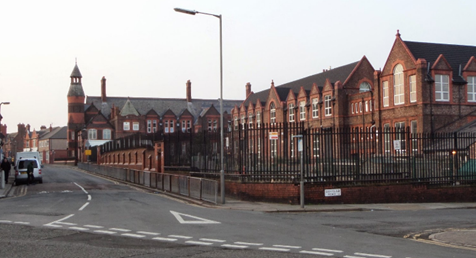
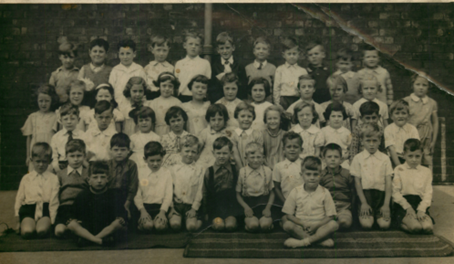
After primary school, Eric progressed to Alsop High School, which stands today as the largest secondary school in Liverpool, after successive expansions after the war. It’s still on the same site on Queens Drive that Eric attended and most of the buildings he studied in are there today.
Liverpool during the 1930s and ’40s was a city deeply affected by the events of World War II. The bustling port made it a prime target for enemy bombings, and the city’s residents experienced the hardships and uncertainties of war. Young Eric grew up amid rationing, blackouts, and air raid sirens, as the war effort demanded resilience and unity from the local community.
In 1940, when Eric was nine years old, the threat of bombings prompted the evacuation of school children from Liverpool to safer areas. Eric, along with many other children, was sent away to Wales. However, the experience was far from enjoyable for him. Homesickness and a longing to be reunited with his family plagued his days, and he yearned to return to the familiar streets of Liverpool.
It was his sister Hilda, six years his elder, who came to Eric’s rescue. She herself lived on a farm near Plymouth, in the picturesque county of Devon, and she invited Eric to stay with her. Eager to escape the unpleasantness of his current situation, Eric accepted her invitation and found solace in the idyllic countryside of Devon. The green fields and peaceful surroundings became his refuge during those difficult times.
After the war ended in 1945, Eric returned fully to Liverpool and resumed his education. Having achieved
In 1949, he embarked on a mathematics degree at Liverpool University. Throughout his studies, Eric displayed a natural aptitude for numbers and a deep passion for the subject. He continued to live with his parents, enjoying both creature comforts and keeping the cost to a minimum.
Anita’s Younger Years
Eric & Anita’s Life Together
In 1956, Dr Eric Wallace embarked on a new chapter in his life. He joined the British Navy as a signalman, not a natural move for him but one necessitated by the requirement to complete post-war national service. Coming from Liverpool though, made the navy the most natural of the services, and perhaps there was some influence from Anita’s family, a big seafaring family.
At the end of that year, on 29 December 1956, dressed in the full military uniform, Eric walked down the aisle with his beloved fiancee Anita at the Parish Church of Our Lady and Saint Nicholas in Liverpool.
Together, they moved to Portsmouth, residing at 6 Ainsdale Road in Drayton.
For the next four years, Eric served his national duty with the British Navy, while Anita stood by his side as a pillar of support. Their time in Portsmouth allowed them to forge a deeper bond and share experiences that would shape their future.
In 1960, after completing his military service, Eric was presented with a remarkable opportunity. He accepted an academic lecturing role at Leeds University, marking a return to the North. He and Anita bid farewell to the coastal city and set their sights on Yorkshire.
Initially settling at 69 Green Lane in Cookridge, Eric and Anita soon decided to establish a more permanent home. In 1972, they purchased a spacious house called Elm Bank in the charming village of Pool-in-Wharfedale. Surrounded by the serene countryside, the Wallace family found a sense of tranquility in their new abode.
Eric and Anita’s family began to flourish with the arrival of their first child, Anita Rachel, in 1966. Their joy was further amplified when Jonathan joined their loving family in 1968. The couple embraced the joys and challenges of parenthood, nurturing their children and instilling in them the same values of perseverance, curiosity, and love for learning that had guided Eric throughout his own journey.
And so, Eric Wallace’s narrative continued to unfold, shaped by the diverse chapters of his life, from the bustling streets of Liverpool during the war to the tranquil countryside of Devon, the academic halls of Leeds University, and the warmth of his own loving family. Each experience contributed to the growth of a remarkable man whose love for mathematics and thirst for knowledge would continue to shape his legacy.