In this chapter of our story, we go back in time to the 1700s, the 3 generations prior to John Blacker, the first to live at Dobella Farm.
Before 1841, information about our ancestors is much less, as we no longer have individual address censuses. Census returns were carried out every 10 years from 1801, but the first three of these did not record the occupants of individual properties, they just recorded the population of villages and towns. Their purpose was purely to monitor population growth and movement across the country at a macro level.
So before that time, we’ve only really got help from parish registers for births, marriages and burials. And very rarely there may be additional information from courts, land taxes, newspapers etc.
Unless, of course, we’re part of a noble heritage, where the records have been kept down the generations. Have a read of the Blacker Origins section to see if that’s the case!
With a lot of the early research, it’s all about ruling out the unlikely, and finding corroborating evidence to support the most likely. Which is usually a lot of hard work, examining records for all people with similar names, following through on siblings to check their documents, and mapping it all out. So bear with me, this will evolve over time.
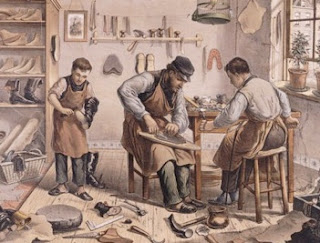
From the research I’ve done, its clear from birth, baptism, marriage and death registers that the 3 generations I’ll focus on here, all shared the same occupation – cordwainers, or shoe makers. Several of their siblings had similar trades, like tailors, so the Blackers of this era clearly shared a passion and skill in making products to wear.
Cordwainers are somewhat more skilled than Cobblers, the latter of which are restricted to repairing shoes, rather than making them which Cordwainers did. Their key material they’d work with was leather, much of which came from Spain, where its name cordewan resulted in the name of the trade across Europe.
Let’s start at the beginning, with the parents of John Blacker from Dobella Farm.
John Blacker (1754-1822) and Mary Durham (1761-1796)
Surprise! The father of John Blacker, and the grandfather of his son John Blacker is… wait for it… John Blacker. In fact, we can be pretty sure there’ll be a John Blacker in every generation, it’ll just depend whether that’s our paternal ancestor or not. And it probably determined quite often whether we accumulated the wealth or not, for John was often the first son of John!
Anyway, this John was born in around 1754. We don’t know an exact date, as all we have to go on is a baptism record – usually these are within a month of the birth, but on this occasion, it was 3 years after the birth! Why so late? Because his parents were not married at the time of the birth, and they needed to wait until they were married before they could get the baby baptised. Such was social and religious protocol of the time.
This led to the slightly unfortunate inscription on his baptism register entry describing him as the “bastard child of William Blaker and Thomasin Knowles of Ulleskelf”. More of William and Thomasin in the next section.

Worth noting at this point that the spelling of Blacker, which I’ll continue to use, was spelt Blaker on the baptism register. Later, it’s Blacker. In prior generations, the name takes many forms, Blackar, Blakkar, Blackkarre, sometimes changing during generations, sometimes between generations, and sometimes reverting. It’s very common, the result of language evolution, regional dialects, individual hearing and writing abilities of registrars, and speaking or writing abilities of the registrants.
After constantly having people write Blacker as “Blacer”, I can imagine William & Thomasin telling the registrar “Blacker with a K” and getting Blaker. I often say Iain with an extra I so I don’t get Ian – and I end up with all sorts, the most common is Iian, but I’ve also had Iani. Seems very odd to me – have people not come across the Scottish Iain before?!
It’s the same with place names, that are constantly evolving, and not just the result of a change in ruling group like Vikings, Normans etc.
John Blacker’s birth place, Kirkby Wharfe is about 18 miles from Snaith on foot or horse, about half way between Selby and Tadcaster, on the river Wharfe, hence the name. I fly over there regularly in my microlight – very flat and prone to flooding in the same way that Snaith is.
Finding him would have been a lot easier if he’d appeared in one of the census returns after 1851, because these give the place of birth. I knew it was likely he moved to Rawcliffe, as I’d literally turned every page of the Baptisms register for nearly half a century and could not find a single John Blacker in Rawcliffe, or nearby Snaith area. Fortunately, Christine Blacker, at the same time I was doing this, had paid a professional genealogy researcher to work on the problem. The research concluded that John had been born in Kirkby Wharfe, the reason being that this is the place his mother was from.
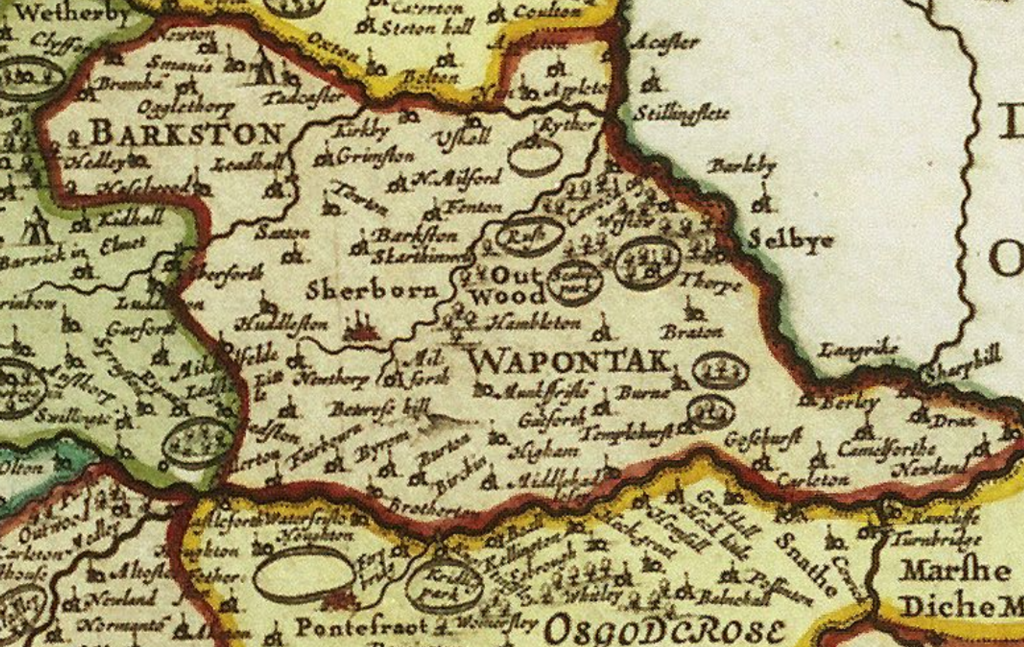
I wondered why this might be so. Why would John, who subsequently lives in Rawcliffe, and whose father came from Rawcliffe, be born 18 miles away? Answer – because that’s where his mother came from. So, how would his father come to travel 18 miles to “meet” his mother? And why would they wait 2 years after the birth before they got married?
I’m afraid you’re going to have to wait for the next section to find out those answers. For now, its enough to say that John was born in Kirkby Wharfe.
Mary Durham was born in 1761, a little younger than John Blacker. She was born in Snaith, the next village along from Rawcliffe, and therefore the likely reason the family settled there.

Mary was the 4th of 7 children born to John Durham and Ann Frier, both of Snaith. The Durham family had lived in and around Snaith for generations – I’ve traced them back the the 1600s and they’ve not moved far. You’ll find numerous Durham gravestones in the St Laurence churchyard in Snaith, several right up to the present day.
Mary’s mother’s maternal families were also from Snaith for generations, so it certainly seems the tradition for the husband to move to the wife’s area if they’re from different places.
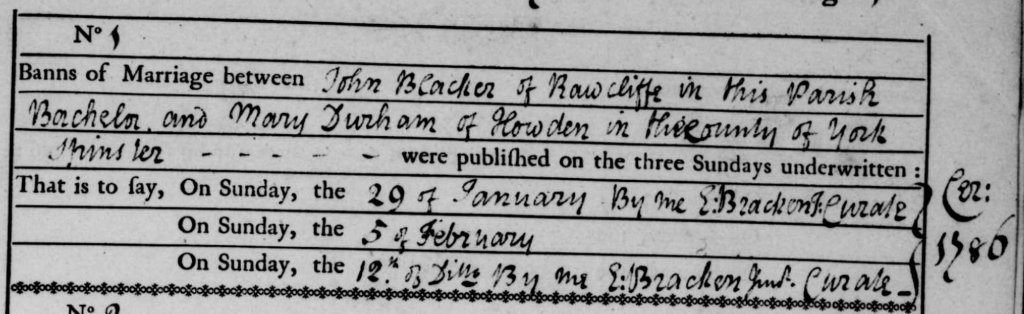
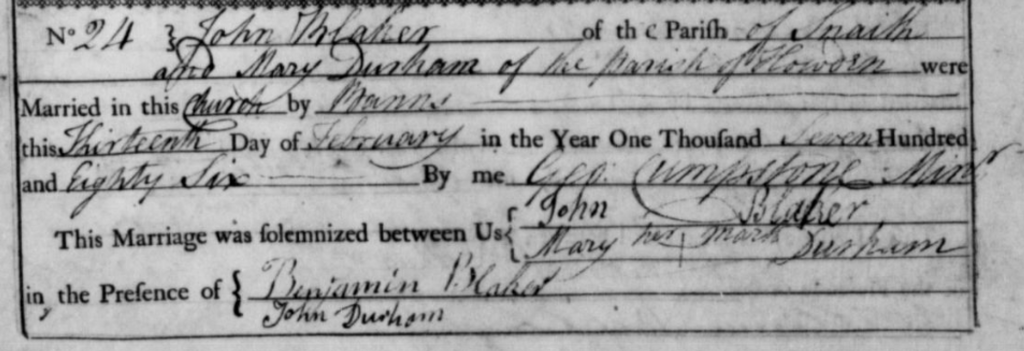
No wonder she would have wanted to stay in the area rather than move to Kirkby Wharfe. They married in 1786 in Howden, banns read up to 2 weeks before in Snaith.
Burials
1796 Blacker Mary 4th Sept, dau of John, cordwainer
1796 Blacker Mary 16th Sept, wife of John, cordwainer
It appears that sadly Mary Blacker died soon after giving birth to her daughter.
William Blacker (1726-1786) & Thomasin Knowles
William Blacker (1683-1736) and Mary Jackson (1699-1778)
William…
Mary was the eldest of 5 children born to William Jackson of Balne & Anne Boyne of Kirk Smeaton, two small village 5 and 8 miles to the southwest of Snaith respectively. Her siblings William, Ann, Dorothy and John were all born in Balne and the family lived there throughout.

Mary was born in 1699, a year after her parents marriage in Snaith, 1 year before the 18th century began. It was the later stages of the Stuart period, when King William III reigned. Perhaps that’s why the name William was popular at that time and we had a change from our usual John Blacker!
Looking back, it was a pretty unsettled time. England had just massacred the Jacobites at Glencoe and Scotland had yet to join England to form Great Britain. And the Battle of the Boyne in Ireland was still a recent event.
Women wore long flowing dresses and corsets and the men had long curly hair, white cravats and carried long swords! Of course, that may well have been the case for the nobles, but for our working class ancestors, you’d struggle to distinguish them from a century or two later.
