My mother’s great grandmother, Isabella Lamb, married John Screen in 1866 in Selkirk. You can read more about Isabella and John in the Screen Family section.
This part of our story looks back at Isabella’s ancestors, the Lamb family, a few generations stretching to the early 1700s. Throughout this period, the family have lived in and around Selkirk in Scotland, and had periods of prosperity and periods of financial hardship. Interestingly, the oldest of the family herded sheep, and I expect this is the derivation of their name, Lamb.
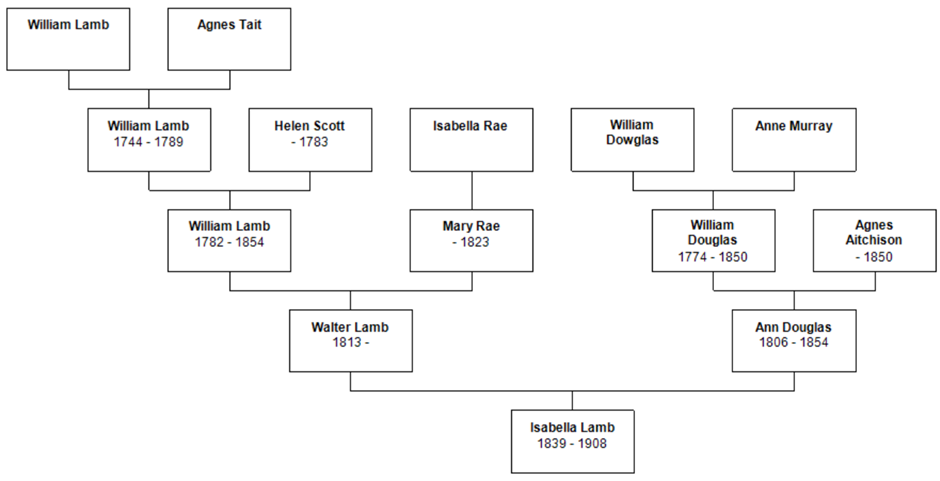
Walter Lamb (1813-?) & Ann Douglas (1806-1854)
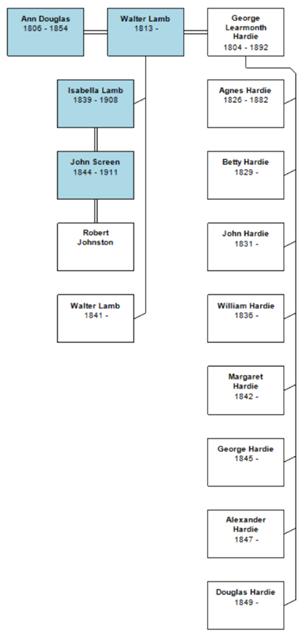
Walter Lamb and Ann Douglas had an unconventional relationship that had a significant impact on their lives and that of their children.
Walter was born into a prosperous family, with his father being a successful nurseryman and prominent civic figure. His mother’s tragic death when he was 10 years old likely had a profound effect on Walter’s life.
At the age of 26, Walter became the father of Isabella Lamb, with Ann Douglas as the mother. Although there is no record of their marriage, Walter and Ann went on to have a son, Walter Lamb Jr., less than two years later. Sadly, neither child was baptised, likely due to their illegitimate status, and their births were prior to the introduction of statutory birth registration.
Isabella and Walter Jr. lived with their Auntie Margaret, Ann’s sister, and not with their parents. This living arrangement continued for all subsequent censuses, and no record of Walter Sr. can be found in any census or death, burial, or any other records. Nonetheless, DNA shared with descendants of Walter’s sister confirms that Walter is the correct father.
Ann was 33 years old when Isabella was born, and already the mother of 3 children, with a husband George Hardie, who she married in 1825!
The first of their children was Agnes Hardie, who would go on to have many descendants who share DNA with the descendants of Walter and Ann’s children. Agnes’ descendants believe that Ann was Agnes’ mother, which is supported by DNA, and by the period in which Isabella & Walter Jnr. Lamb were born falling within the 6 year gap in which Ann and George Hardie had no other children, prior to recommencing.
In the 1841 census, Ann’s children with George Hardie were living with her and George, along with two other children, William and Helen Douglas, who were born within the same six-year gap as the Lamb children. It is unclear whether these two children were George’s or Walter’s, but they were the only ones who appeared to have gained the Hardie surname in subsequent censuses.
Ann died in 1854, and her burial location is unknown. Despite the lack of information about their relationship, the shared DNA between their descendants provides some insight into Walter and Ann’s story, which has come to light so many years later.
William Lamb (1782-1854) and Mary Rae (?-1823)
My 4th great grandfather, William Lamb, was born in 1782 in Selkirk, son of a merchant and grandson of a Shepherd. The family were on the way up the social ladder and William junior certainly continued that trajectory for by 1813 he had been appointed Treasurer of the Burgh of Selkirk. The Treasurer was responsible for managing the finances of the town, including collecting taxes, fees, and other revenues, as well as overseeing expenditures on projects such as road repairs, construction, and other public works. The Treasurer was accountable to the town council and had to maintain detailed records and books to ensure that the finances were kept in order. The role required a high degree of financial acumen and organizational skills, as well as an ability to work effectively with other officials and members of the community. In Selkirk, the role of Treasurer would have been a significant one, reflecting the town’s status as an important centre of trade and commerce in the Scottish Borders. Perhaps that’s where I get my financial and accounting acumen!
William’s social standing and public duty did not end there, for by 1815 he had also taken on the role of Baillie, a high-ranking official responsible for maintaining law and order in the town.
During this time William had met and married a local girl by the name of Mary Rae and together they began building a lovely family. The Lamb family lived on Water Row in Selkirk during these years, a picturesque street that runs along the banks of the Ettrick Water. This area of the town was known for its beautiful gardens and green spaces. It’s possible that this is where William ran his business, for his public duties were in addition to his main role as a nurseryman and seedman. This is someone who grows and sells plants, trees, and shrubs for ornamental, decorative, or practical use. They typically operate a nursery, growing and propagating plants and seeds for sale, so perhaps the nursery was located around Water Row.

Sadly, family life was shattered in 1823, when the joy of the birth of their 6th child, George, was followed by the death of his mother, Mary.
Despite the tragedy of his wife’s death, William remained active in public life and continued to serve as Baillie until his retirement. His mother-in-law Isabella Rae came to live with the family after her husband’s death, and his sister-in-law Agnes Rae also moved in as housekeeper. They also had a house servant, one of the benefits of his position.
William died at the age of 72 and was buried in the family plot in Auld Kirk graveyard in Selkirk, along with his wife Mary, eldest son William, and youngest son George, as well as their spouses. The Lamb family plot is a testament to their long and proud history in the town, and their contributions to the community over the generations., his wife Mary, eldest son William and youngest son George, along with their spouses, are buried in the family plot in Auld Kirk graveyard in Selkirk.
The family business seems to have continued under the operation of George, the youngest son, although several of his siblings had related occupations, so its possible they worked together.
William Lamb (1754-1822) and Helen Scott (1744-1789)
William was born at Hartwoodmyres, a country estate a few miles down the Ettrick Water river from Selkirk. In early times this was part of the Ettrick Forest and was kept for hunting by landowners and the Royal court. The name Hartwoodmyres is very descriptive – hart is another name for deer, wood describes the forest and a myre is an area of marshland. In medieval times the land was turned over to sheep rearing – largely for wool, hence the growth of the Woollen industry in the Borders. Which is why William was born here – his father, also William, was a lamb herd on the estate. The Ogilvie family owned Hartwoodmyres Estate from 1695 until 1882 and would have been the employers of the Lamb family.
Given the family name Lamb, and the fact that William’s father was a lamb herd on a sheep farm, it’s reasonable to believe that this is where the name originated and that the family, perhaps going back several generations, were sheep farmers or shepherds.
William married Helen “Nelly” Scott in the Auld Kirk at Selirk in 1776 and had at least 5 children, including our Ancestor William junior.

By the time of his death in 1776, William had become a local merchant, perhaps trading wool for the expanding woollen trade for which the whole area had become dependent at that time.
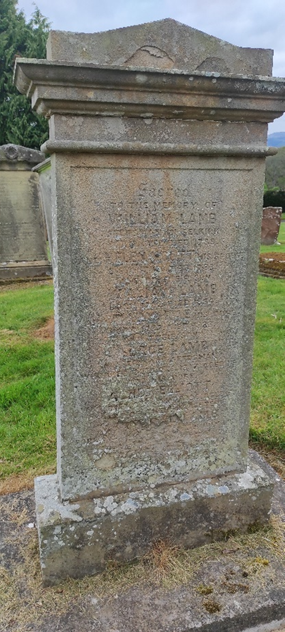
He and Nelly, along with 3 of their children and their spouses, share a headstone in the Auld Kirk graveyard in Selkirk, which Rachel & I discovered in 2023.
William and Helen had 5 children, including our ancestor William. The other names Isobel, Agnes and George are all common names through the Lamb generations, but not surprisingly, Currie Lamb is a one off. If it was a name today I’d think it poor humour, but given it was Scotland in the 1800s, perhaps it was just an error in the recent transcription of their birth record!