My great grandfather, John Spence of Couper Street, Goole, was the son of an Innkeeper from Knottingley by the name of William Edward Spence, and on his transition to farmer & scavenger in Goole he and his wife Mary ran a public house in East Cowick.
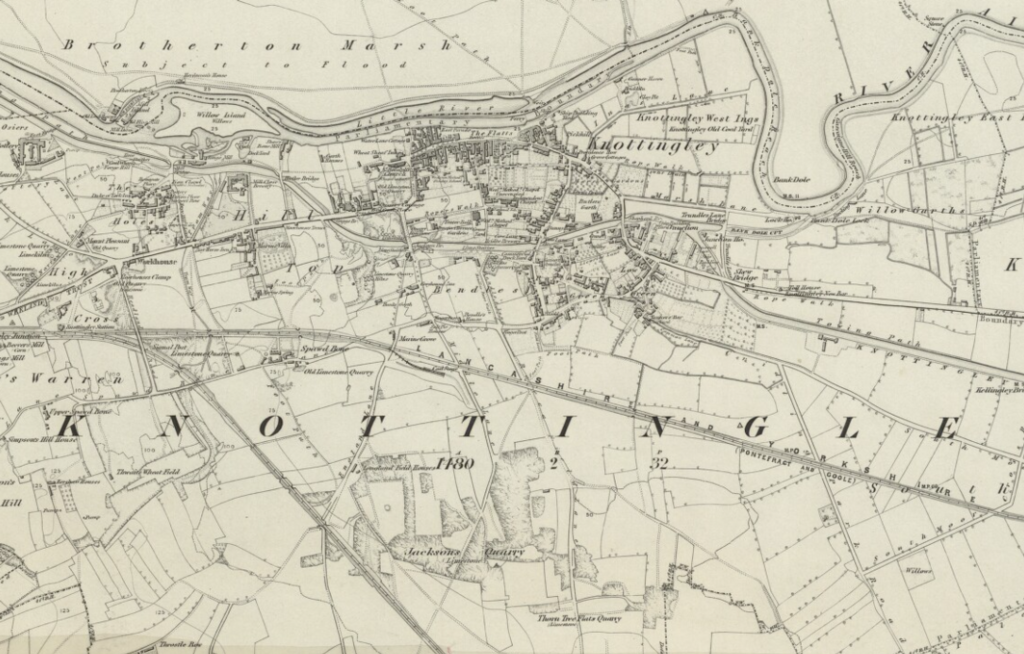
Knottingley has long been on the map predominantly by virtue of its position on the river Aire. It’s thrived throughout its history on the transport of goods between West Yorkshire and other destinations navigable by sea. For many years it was a large inland port with ships travelling up the Humber and Aire to the town. The Aire & Calder Navigation project, a canal section which allowed transport all the way to Leeds, was completed in 1704 and extended in 1826 – this reduced the importance of Knottingly as a port but it continued to serve passing trade and to build ships.
The railway came in 1840s and the road network also became more important for transport, but for much of the 19th century, Knottingley’s economy was dependent on the waterways. Many of the families from Knottingley were therefore mariners and those involved in transport such as ship builders, horse drivers, hauliers and bargees.
Many others were farmers, with very fertile land outside of Knottingley in the flood planes of the Aire.
Oliver Cromwell stayed in Knottingley during the sieges of Pontefract in 1648. He stayed at Wildbore House, which was later demolished in order to quarry the limestone from under the house. This was one of many parts of the area to be quarried, and a lot of the local economy was based on it. Glass-making requires calcium carbonate from limestone, and a large glass factory sprung up and is still there today.
Many other families were in support of those industires, as they are in all towns – shop keepers, professionals and our very own innkeepers.
For those who did own or operate an Inn, they generally did so whilst maintaining another job – quite commonly farmers. It’s not clear whether this was because there was insufficient income in the inns themselves, or whether they made their money elsewhere and invested it in a pub. There are examples of both types of landlord to be found in the history of Knottingley.
Until 1841, there are no census records, and the further back we go, the less information is readily available on baptism and other records. Researching therefore goes back in time, building on the information we have nailed down, and only progressing when we can reconcile and confirm the later generation.
Innkeeping is in the blood of the Spences and for the sake of telling this part of our story, we start our journey with the first of 3 generations of Knottingley Innkeepers spanning 3 centuries, and work our way forwards.
Edward Spence (1777-1842) & Mary Milner (1764-1851)
Edward was the eldest son of Robert Spence and Sarah Taylor, farmers from Warmfield near Wakefield, who moved to Knottingley after their marriage in 1776.

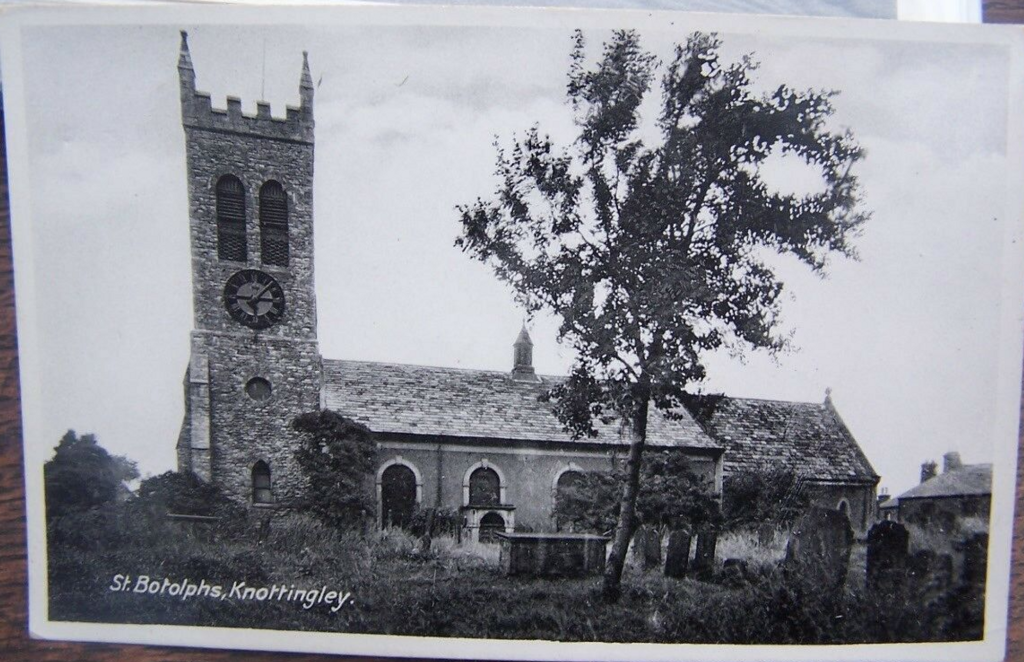
The baptism record can be found on 28 September 1777 at St Botolph Church in Knottingley, though it’s somewhat lacking in information compared with those that follow in later years.
Whether Edward had formal schooling cannot be confirmed, but there was a school very close to St Botolph so it’s entirely possible, though not a legal requirement at that point.
Mary Milner was born in Leeds, more than 12 years before Edward, and in some way that is lost in time, she met Edward and married in Darrington, 4 miles south of Knottingley. Why Darrington? I can only assume that Mary’s family had moved there. There was, and still is, a large limestone quarry at Darrington, and little else, so it seems with the context of what is to follow, that Mary’s father may have worked at the quarry, as perhaps did Edward.

It’s interesting that one of the witnesses, William Taylor, who I believe was Edward’s cousin or uncle. Interesting because William, a cooper by trade, established in 1813 the very first Public House in Knottingley, the Rising Sun, in a house on Hill Top at the corner of Marine Villa Road.
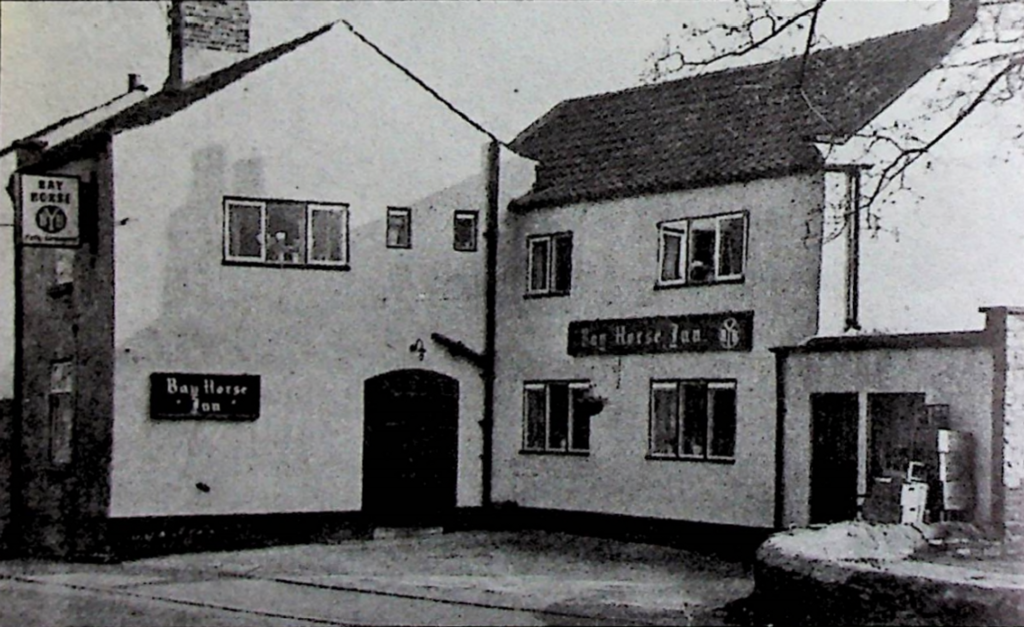
He took a 7 year lease, which he did not renew, instead moving to take on the Bay Horse, only a few hundred yards along Hill Top. This pub stayed in his family for over 50 years. Sadly, it’s now buried beneath a Morrisons supermarket. Through his time at the pub, William Taylor was described not just as an Innkeeper but as a Lime Trader.
In the first few years after marriage, Edward worked several jobs, as was common at the time. In 1801 he was described as a farmer, 5 years later a waterman. When William Taylor (Edwards marriage witness) moved to the Bay Horse pub, Edward & Mary took on the Rising Sun. In the same way that William Taylor operated as a lime trader whilst running the pub, so too did Edward. The Rising Sun, like several other public houses in Knottingley, had a lime kiln attached in an outbuilding.
Edward would get limestone from the local quarries, transport it to the Rising Sun by horse & cart, burn it in the kiln to produce quick lime, and then once he’d produced enough, he would transport it up the waterways, by barge, to Goole, or sometimes beyond as far as Hull.
In this way, he would control a significant portion of the supply chain, not just a single part of it. But in order to do this, he could be accused as a jack of all trades – a labourer & haulier to collect limestone, an innkeeper by virtue of the premises he had to burn the limestone, and a mariner or waterman to transport the end product to his customer. I regularly fly past an enormous factory or warehouse alongside the river near Goole, and look down on a mountain of lime, and think about all the centuries of history that has gone before to get that business to its current state. I also think about Edward and his entrepreneurial drive and hard work, and his turning his hand to several different jobs in order to hussle an income. When I try to describe my own job to people, I think of Edward, as like him, I earn a living through several different means, a jack of all trades. And, I spare a thought for Mary, who not only kept the home life running smoothly, but ran the pub. Not an easy task, and no doubt there were many times when Edward was away on business, delivering lime, and she managed it all alone. It was a successful partnership and marriage that lasted over 40 years and reminds me of my own with Rachel.
Over the next decade, Edward & Mary had 5 children, all baptised in St Botolph church.
Their first born was Mary Ann, born in 1798. No doubt that Mary’s father was a well known face in the world of mariners, and at some point this led to her meeting William Clough, who later became a well regarded ship builder.
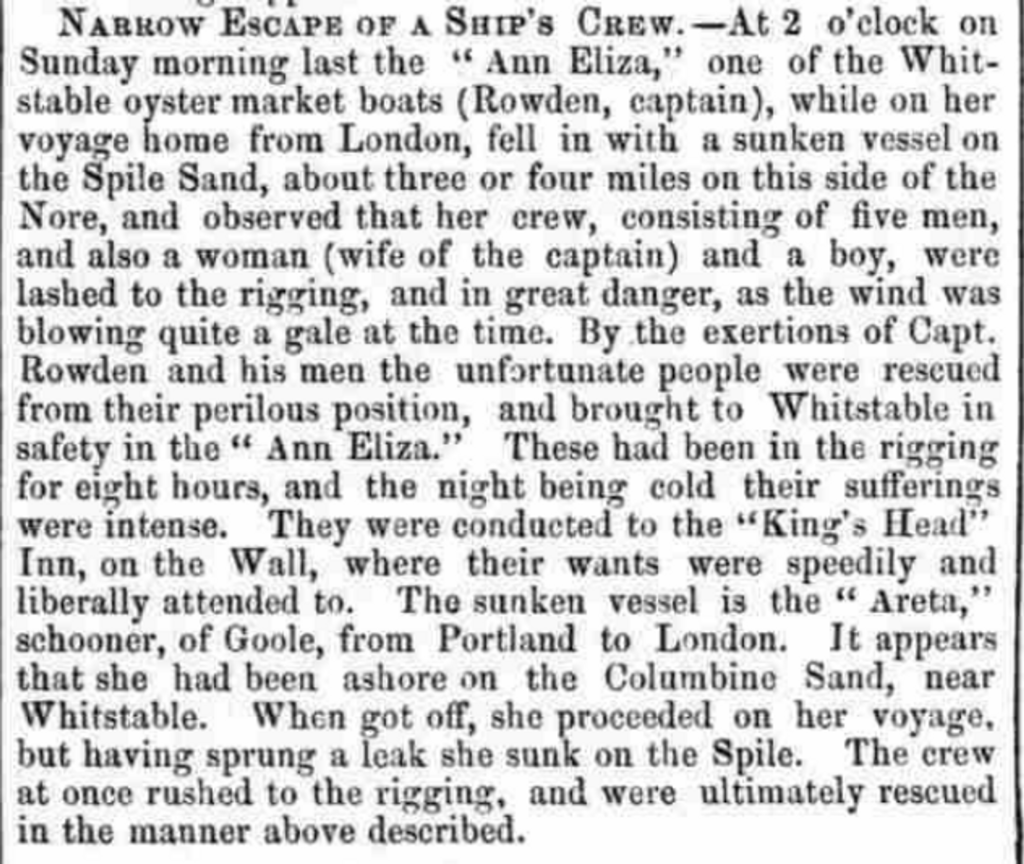
His notable achievement was the building of the 65 tonne ship Areta, registered in 1866 but sadly lost only 2 years later, when it ran aground on a stormy night in dramatic circumstances.
Their second child was John, who unfortunately died in infancy. Their are no records from that period, so we can only guess at the cause. Needless to say, child mortality was significant at that time with nearly 1 in 5 children likely to die.
Their 3rd child, Edward, was born 2 weeks before his elder brother died. Edward junior, now the eldest son, followed in his father’s footsteps, trading lime and transporting it up the river. I believe he did this as part of his father’s operation rather than in his own right, for when his father died, he moved from the Jolly Sailor pub to Racca Green in Knottingley and became a farmer.
Edward junior married Anne Downing, a girl from Fishlake, and together they had 5 children, 3 girls and 2 boys.
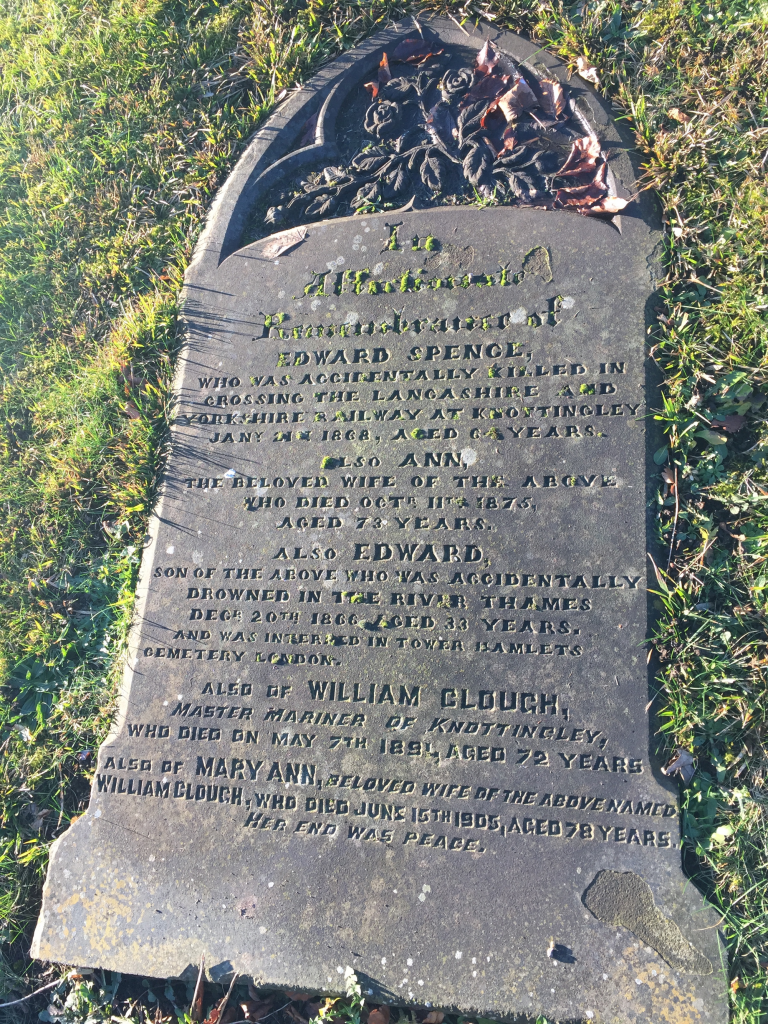
His eldest son, who they also named Edward, took on one of the family occupations and became a mariner, at sea at the age of 18, married and with first child at 28 and living in Aire Street in Goole. Sadly, in 1866, a week before Christmas, on a trip to London, disaster struck and Edward drowned in the Thames. He was buried in the cemetery at Tower Hamlets.
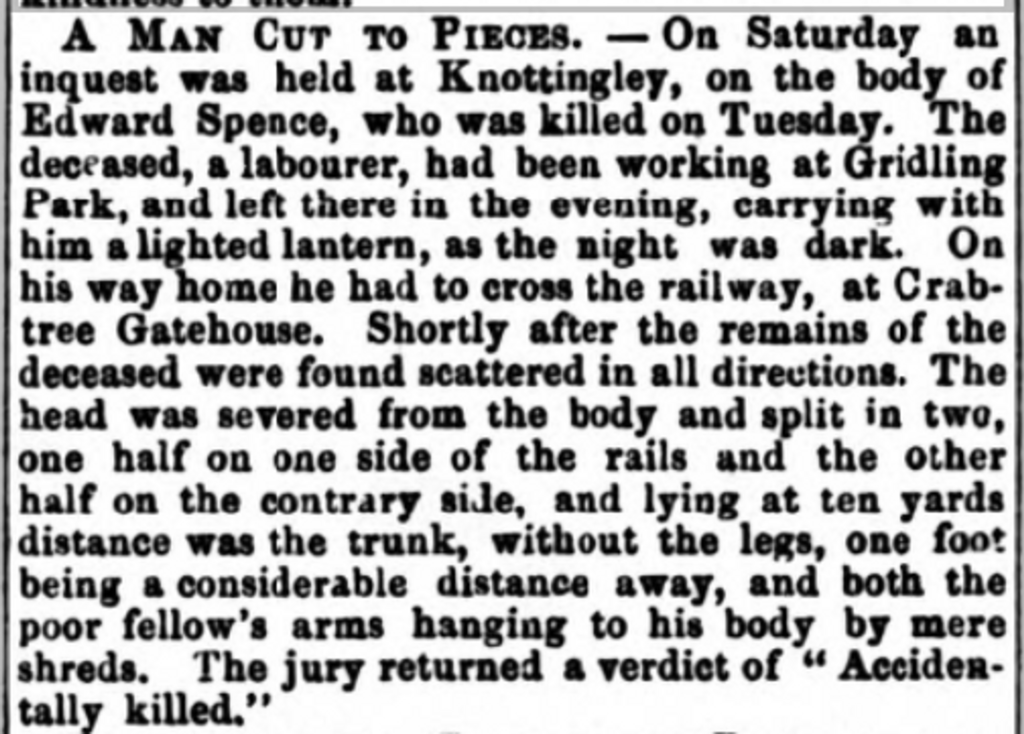
Unfortunately this was not the end of the tragedies for this family. Just over a year after his son drowned in the Thames, Edward junior was returning home one evening, from working at Cridling Park, about 2 miles south of hime. He was 65 years old at this point. The time was 5.40pm.
Crossing the railway line not far from home, he was hit by a train. The newspapers carried the story, in graphic detail – his head was severed and found up the track from his body, which was dismembered and cut in two.
So in the space of 12 months, two generations of Edwards killed in very sad circumstances.
The 4th child of Edward & Mary, was John, my own 3x great grandfather who I will discuss in his own section below.
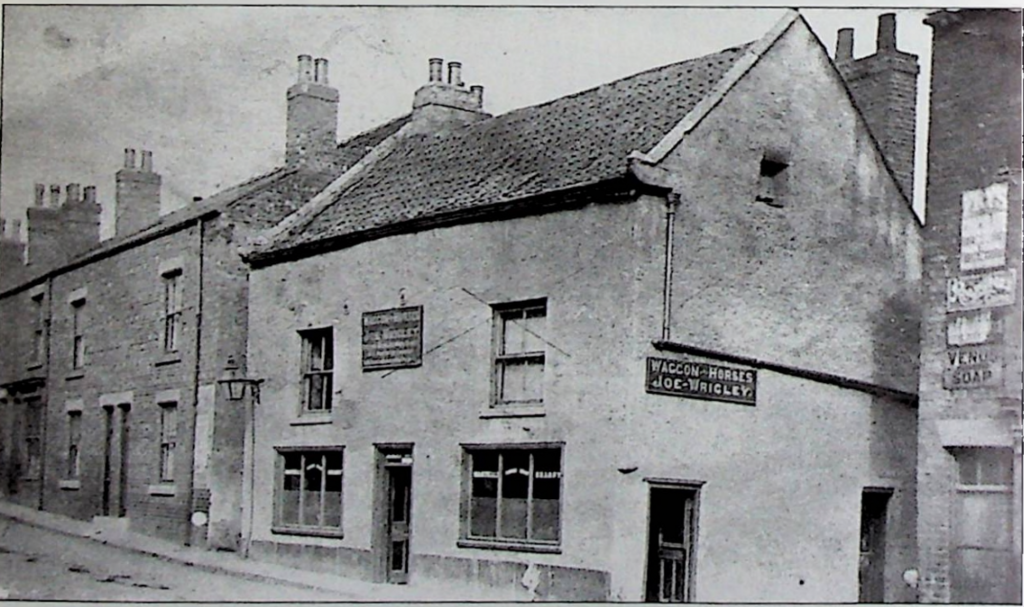
The final child of the family was George, who married Priscilla Cawthorn and became the landlord of the Waggon & Horses. My brother Phil, doing his own research at the British Library where he was a boss, sent me the photo to the right of the pub, and mention of George from 1837.
Back to the story of the parents, our direct ancestors, Edward & Mary. Whilst their own children grew up, they continued to work hard, Edward making quick lime and transporting it up the river, Mary serving in the Rising Sun. By 1827, they’d earned enough to buy their own place, and so in that year, the John Bull opened, on the canal side at Manor Fold.
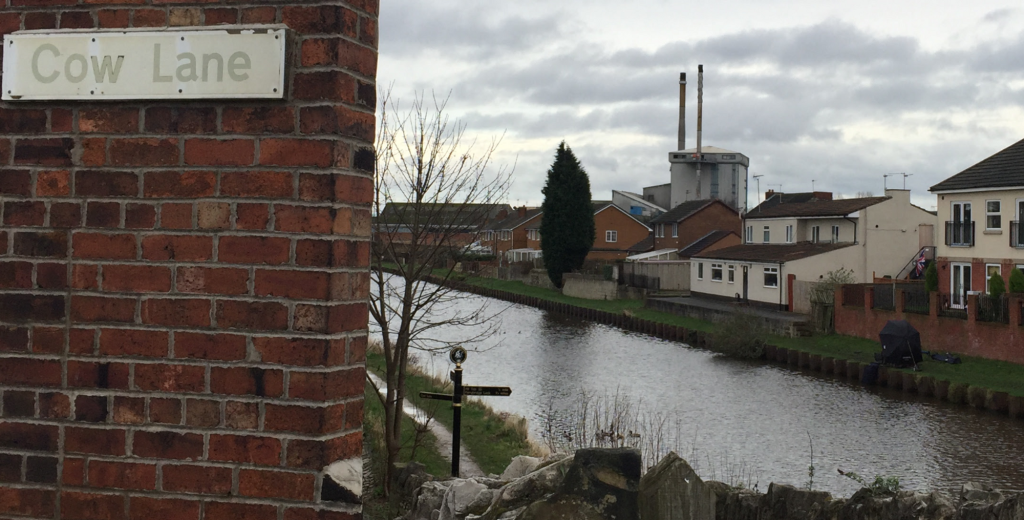
It’s still there today, I’ve visited a few times, it’s now a working mens club. Back then, I can imagine lime being loaded onto a barge from an outbuilding where the flats now stand, and a general hussle & bussle outside, people sitting out drinking overlooking the water.
And then, sadly, my 4x great grandfather Edward died around 1834, less than 60 years old. I can find no records on the detail.
Life appears to have continued in a stable way for several years, the Inn appearing in various trade directories.
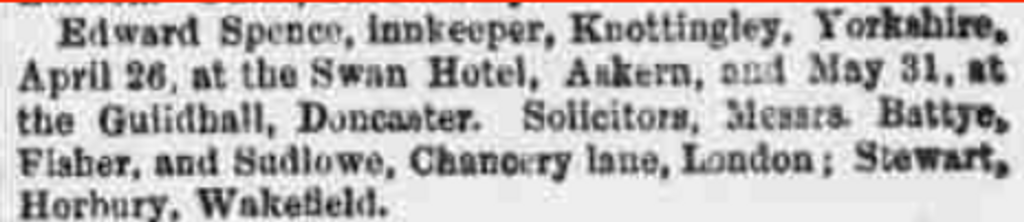
His widow, Mary, sold the freehold to the pub to a weathly local shipbuilder, William Dey, who kept Mary on as the licensee. At this point Mary was 75, and therefore relied heavily on her son Edward and his wife Anne, to run things day to day, and on the second renewal, the licensee changed to Edward.
And then things took a turn for the worse. Edward & Anne were unable to pay their debts – maybe business had taken a downturn in the pub, or the lime trading, or perhaps an investment had turned bad. I suspect I’ll never know, but in 1842, Edward petitioned for bankruptcy.
The business his father had created, had been lost within 8 years of his death, and his son returned to labouring to earn his living. 25 years later, he was still labouring when he was hit by the train. A tragic end to a somewhat troubled life.
Mary, our 4x great grandmother, lived to the ripe old age of 87 and died at home in Racca Green, where she’d lived out her final years with our 3x great grandparents, John & Mary Ann. Though she was buried in St Botolph, I can find no gravestone.

John Spence (1806-1865) & Mary Ann Saul (1804-1886)
John Spence, was the 4th child of Edward & Mary, and my 3x great grandfather. He was named after his elder brother who died in infancy before this John was born.
John was born in 1806, in Knottingley, and baptised at St Botolph church. At the time, his father was a waterman, transporting lime up the waterways.

In the the years that followed, John would learn many of the trades from his father – mariner, labourer, farmer, lime trader and inn keeper.
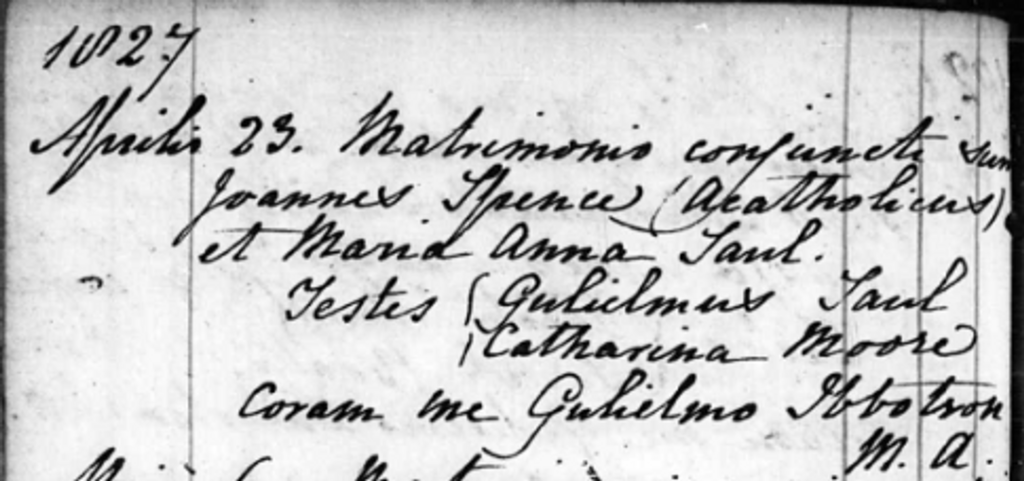
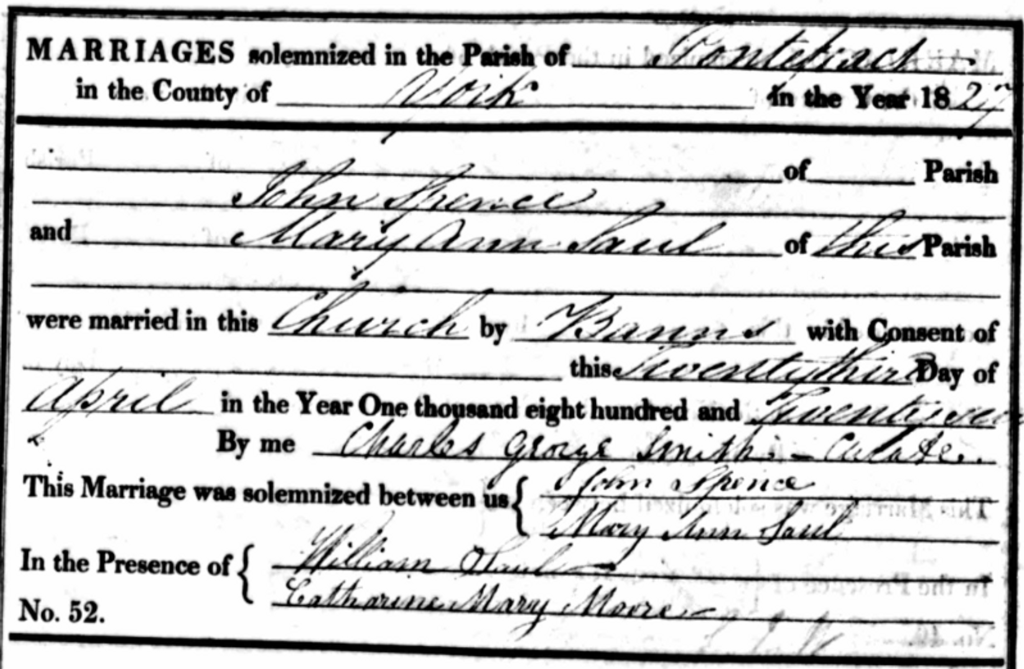
In 1827, John married May Ann Saul, a Knottingley girl, daughter of labourer Michael & Winnifred.
It’s quite an unusual surname in most places, yet in Knottingley I see a lot of gravestones bearing the name. It’s funny how there are pockets of family names all over the country.
They were married at St Giles with St Mary’s church in Pontefract. Interesting to see the baptism record written in Catholic latin, with the Bishops Transcript documented in English.
In the next few years, the couple had 5 children. The first, Richard, was born the same year they were married and sadly died before adulthood, aged 11.
The second child was our 2x great grandfather William Edward, who we follow later on.
The third child was John, like his father, my father and my grandfather. John was born in November 1831, whilst his father was still a waterman, and died a baby of barely 6 months.
The fourth child Anne, was born in 1834, died just less than a year later. Her father was still a waterman at this time. You’d imagine that after losing 3 out of your 4 children, they might give up.
Instead, they had one final attempt, and named the child Ann, after the latest one who died. She was baptised in 1837, but I can find no further records for her, and she is not living with John, Marry Ann and William in 1841, so we must assume she also died an infant.
So for our 2x great grandfather William Edward Spence to be the only one of 5 children to survive makes us either lucky, or survivors, or both. What’s sure is that if he hadn’t survived, most of us reading this wouldn’t be here today!
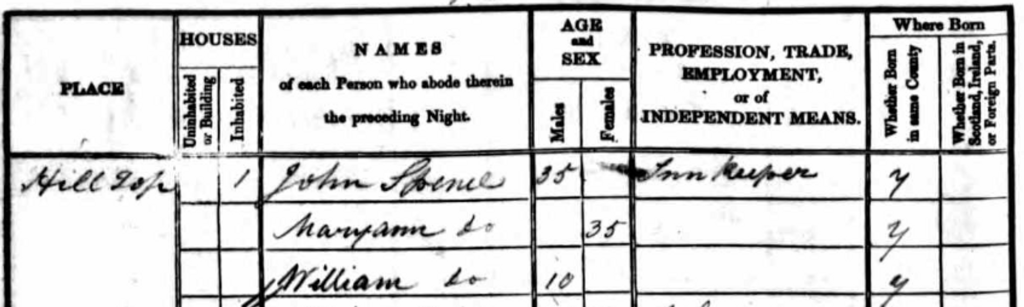
So in 1841, John and Mary Ann were living with their son William Edward Spence, my 2x grandfather, at Hill Top. Described as an Innkeeper, it’s likely that John took over the Rising Sun from his parents when they took on their new inn at Manorfold by the Canal.
Given that it had a lime kiln attached, it’s likely he carried on the lime business as well.
So around that time, the Spence family would run the Rising Sun, The Jolly Sailor and the Waggon & Horses. Quite a stranglehold on the innkeeping market!
After John’s father died in the 1830s, and his mother struggled to keep the business going for the next few years, John, like his brother Edward, appears to have returned to labouring to make ends meet. The Rising Sun was sold and the license changed hands.
But unlike brother Edward, who went bankrupt and ultimately was run over by the train, our ancester John fought back. Slowly. In fact, it might be more accurate to say he survived. And his wife Mary, she survived longer.
In 1851, John and Mary Ann were living in Racca Green, with John’s 87 year old mother, who died later that year. And in 1861, the couple were living at Albert Cottages, Foundry Lane, next door to the Jolly Sailor inn, which of course was no longer in the family by then.
John died in 1865. There are no details of his death and he appears not to have been buried, or at least there are no records. As a labourer for the last few years, the family money long gone after his father’s death, we can assume that there were not funds for a headstone.
Mary Ann lived on for another 20 years, but did not remarry. She lived alone in Canal Side, which may well have been the same cottage at Foundry Lane she’d lived in with John, as foundry Lane and Canal Side are much the same place. For her final few years, she did part time cleaning work, described as a Charwoman, to make ends meet.
She died aged 82.
William Edward Spence (1830-1913) & Elizabeth Bramham (1833-1900)
It’s fair to say that the Edward Spence & Mary Milner made money and the next generation, John Spence & Mary Ann Saul (and John’s other siblings) lost it.
William Edward Spence, the only one of John & Mary’s children to make adulthood, spent his early years surrounded by the Innkeeper & Lime trader life, living for much of his childhood at the Rising Sun with his parents and visiting the Jolly Sailor owned by his grandfather.
Looking at his life in its entirety, it followed a similar pattern to his fathers.
Marrying young allowed the couple to have 9 children! And fortunately, more than one of them survived to adulthood.
His early adult life was spent working as a mariner, no doubt transporting lime. I think he was at sea in the 1851 census, but when he returned, he married his sweetheart Elizabeth Bramham, an 18 year old dressmaker from Aire Street. Bramham is a well known name in the area, but this branch were focused on dressing the Knottingley folk. Elizabeth’s father and elder brother were both shoemakers with a shop on the main Aire Street.
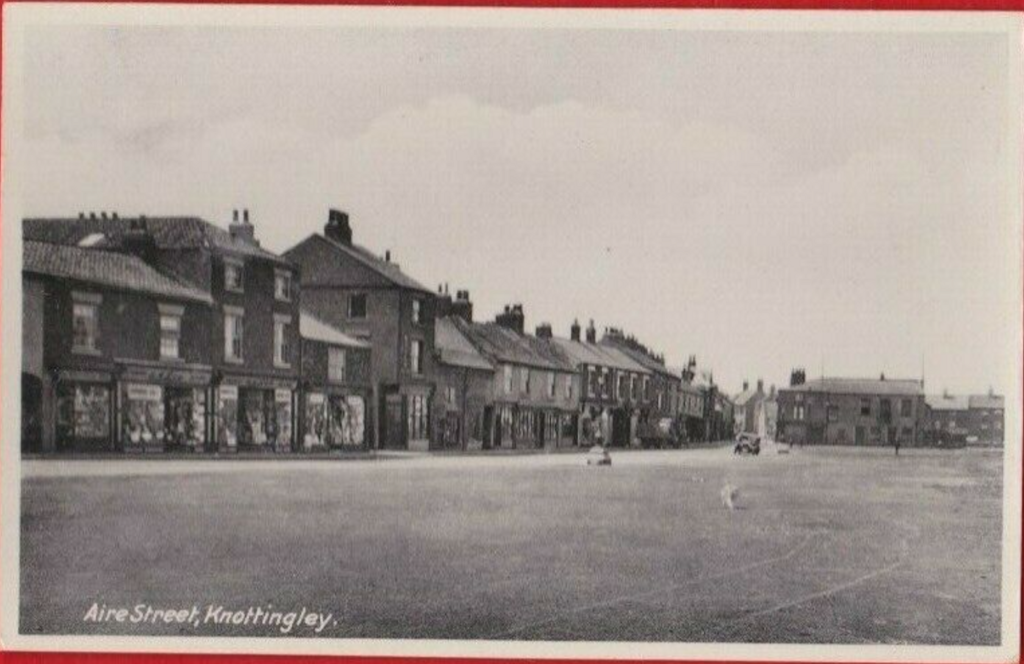
At the time of Mary’s birth, it seems likely he’s still involved in the barge world having likely been afloat at the time of the 1951 census a year earlier.
Mary Hannah was their first child, born in Knottingley in 1852, a year after they were married. At the time of her baptism, William Edward was noted as a farmer, though as we’ve seen with his ancesters, he’s a bit of a jack of all trades having been described at various points as a farmer, horse keeper, hauler, mariner and then in later life an innkeeper. Whilst this sounds like a lot of change, in reality it describes the man who makes a living transporting goods up and down the river, tugging a barge with a horse.
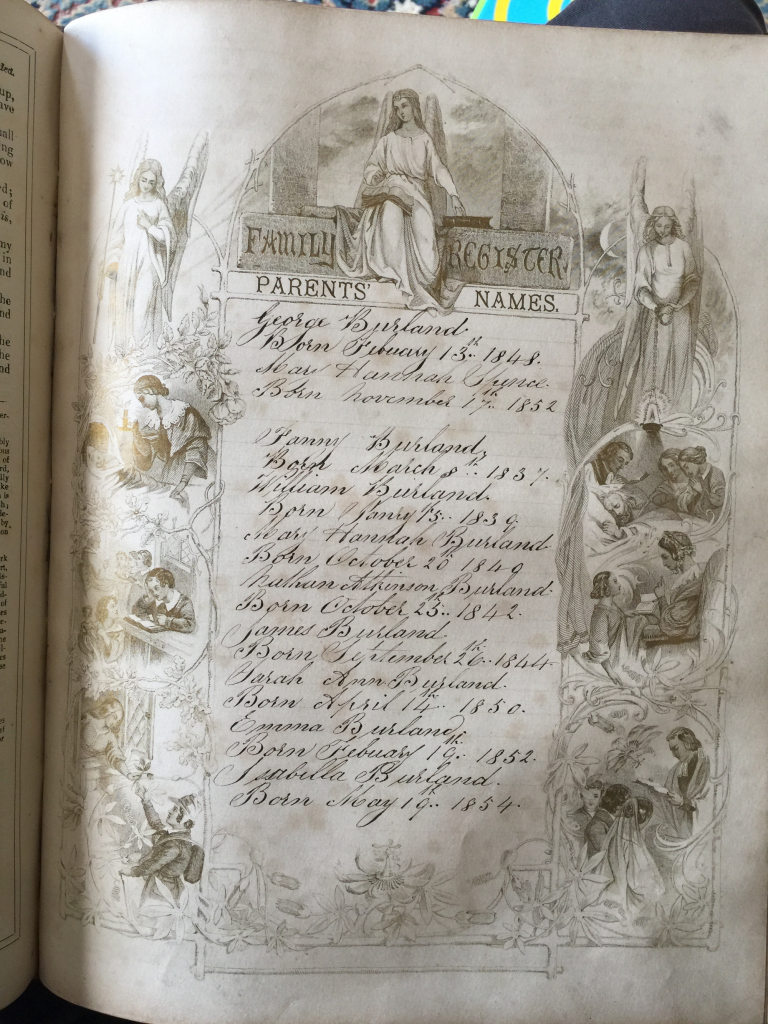
Perhaps it’s not surprised therefore that Mary married a Burland. George Burland was the son of William, a mariner, and Mary, from Anchor Yard in Knottingley. The family were bargees for a number of generations. My father, John, remembers visiting a barge on the canal in his childhood to visit a Burland – this could have been Mary as she died when John was 5 years old. The couple had no children. Their house was their barge, which appeared at various places around Knottingley at census time.
My father also possessed a family bible, now passed to my sister Mandy, which was first owned by Mary & George and contained the names and birthdates of George’s siblings.
The second child was my great grandfather John, who went on to marry Mary Glew – you can read about them here.
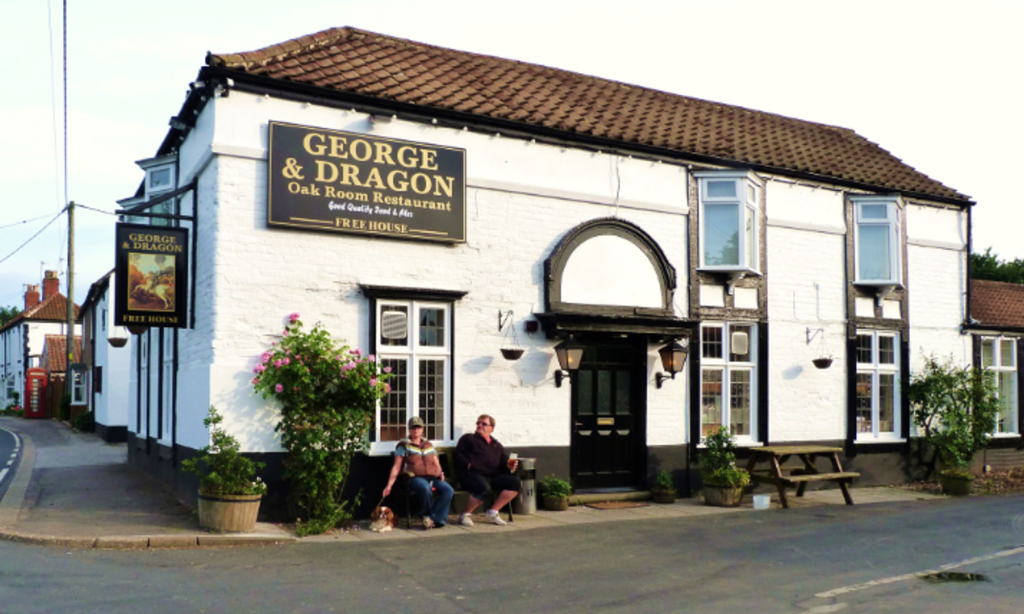
The third child was James William Spence, born in 1858. He married Ann Rhodes and they had 3 children together -Edith, Percy and Anne. James started his working life as a woolen dyer, and after a period of time as the ferryman helping people across the Aire at Knottingley, he took the license to the George Inn at Holmpton in about 1890. The pub is still there, a well regarded eating place, but now called the George & Dragon.
After a few years in Holmpton, the family returned to Knottingley where James & Annie ran a grocers shop in Island Court, close to his parents.
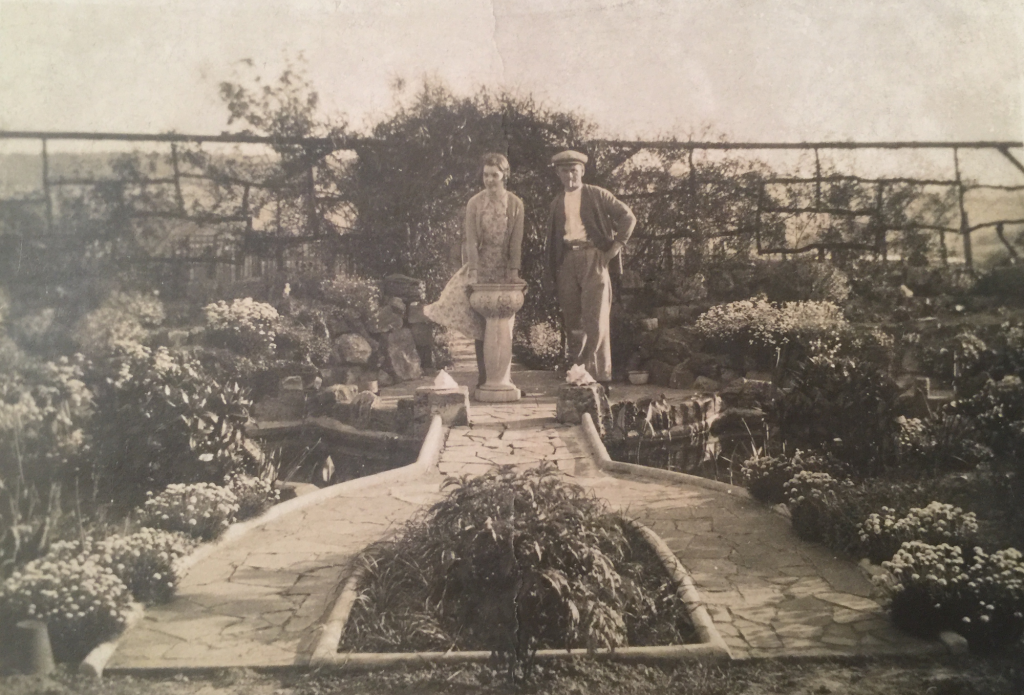
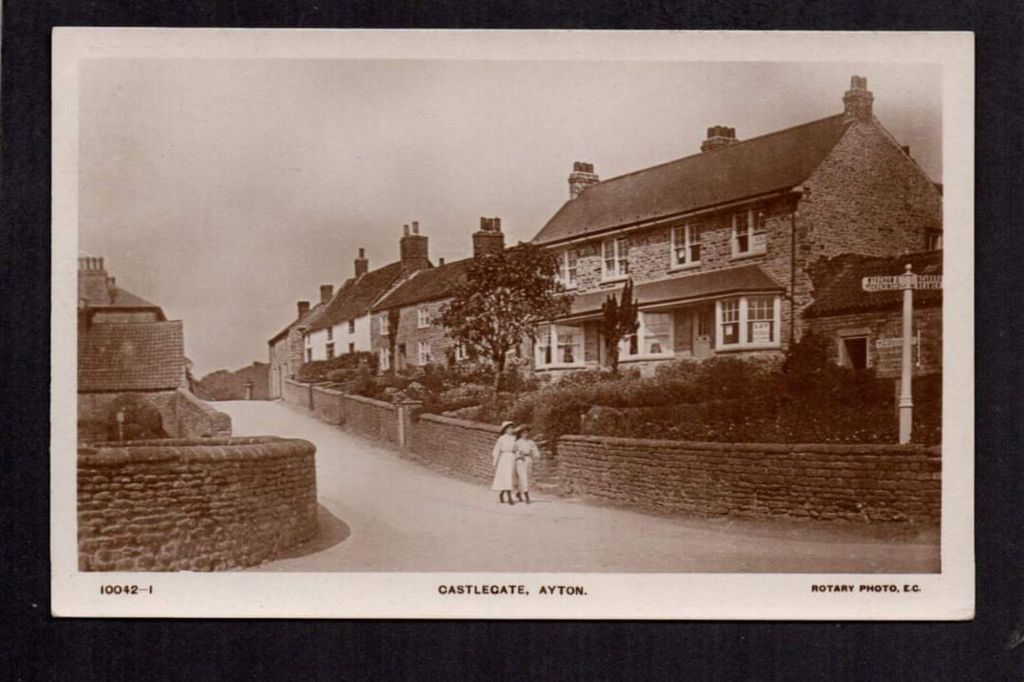
Their son Percy married Kathleen Boocock in 1910 and got a job as a builders builders clerk in Castleford. He was a good draftsman. They had no children.
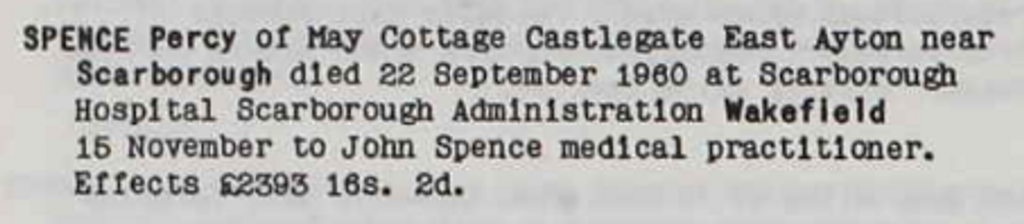
Later in life, Percy had moved to a village near Scarborough, East Ayton. His doctor there was John Spence, my father. They struck up a relationship, John used to visit him occasionally, and when Percy died in 1960, he left his estate to John. The sale of his house funded a new surgery in the village.
The fourth child of William Edward & Elizabeth was Elizabeth Ann, who was born in 1861 and died before her 2nd birthday. She was followed in 1864 by her namesake. Elizabeth Ann survived to adulthood, marrying Samual Wood, another Knottingley labourer in 1885 and having 6 children together – Herbert, Fred, George, John, Samuel & Emily.
The fifth child was Robert Spence, who married Mary Elizabeth and had 3 children Martha, Elizabeth and John. The next child was Harriet who died in infancy.
The penultimate child was George, a farmer who married Sarah Elizabeth Bradley with whom he had Charles, Walter, George, William Edward and Albert. It’s lovely to see the same combination of names passing through the generations and merging with those from the spouses family. It always helps me know I’m on the right track when I’m doing my research when I see the same names popping up.
The final and 9th child, Albert, died at the age of 10, in 1884, when his parents were 50 & 54 years old.

Back to the parents, my 2x great grandparents, William Edward and Elizabeth.
Having started his working life as a mariner, and then a horsekeeper, pulling the barges up the canal, he followed in the family tradition in the 1860s, taking on the license for the Ship Inn in Knottingley.
The Ship Inn was established on the Aire bank at the edge of the Rowcroft where vessel construction and repair was undertaken before the eighteenth century.
The Inn came with four adjacent cottages which had previously been used as a brewhouse, a paint shop, blacksmiths shop, boat sheds and stables. I found an interesting advert for the sale of The Ship from 1820 which gives a good description of the property.
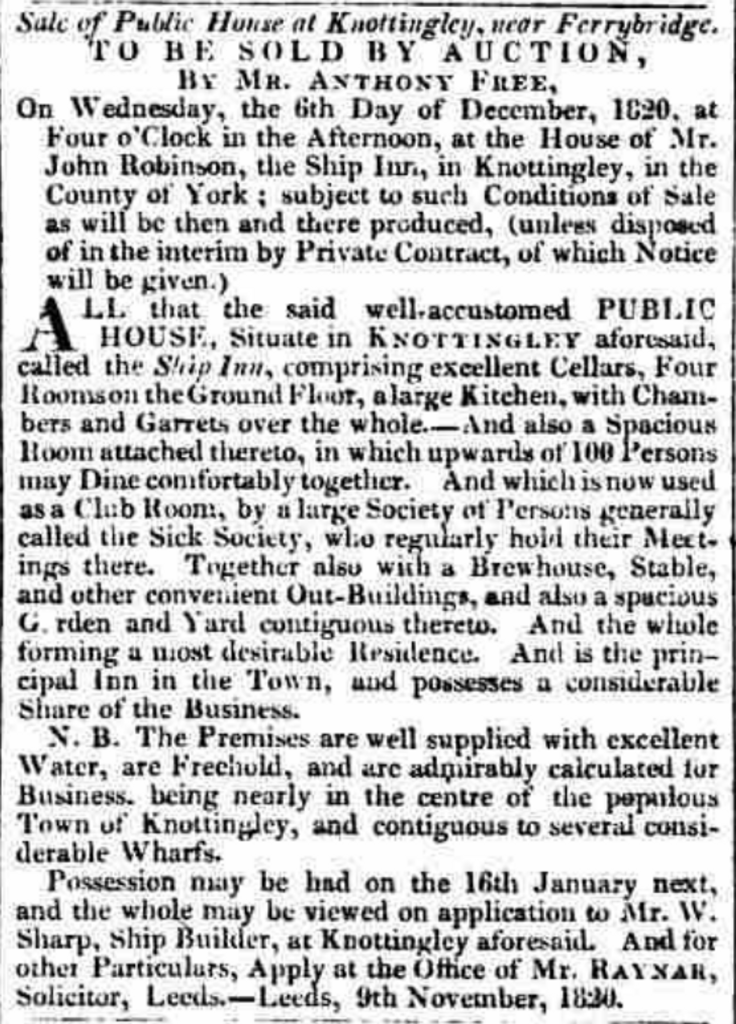
Life at the Ship was far from dull, and William would have much to contend with.
On one occasion, the police were called to the Ship Inn around midnight to find a body of at least forty militiamen, drunk and disorderly, had taken possession of the premises. Eventually, becoming weary of the tumult, the soldiers ‘fell in’ and marched in disorder along Aire Street.
Some, armed with cudgels, amused themselves by breaking windows, others by assaulting innocent passers-by whom they encountered as they quit the town. The soldiers had been undertaking training at Pontefract throughout the previous month and it is somewhat ironic that the previous week the local paper reported favourable comments by the citizens of the town concerning the soldiers good conduct.
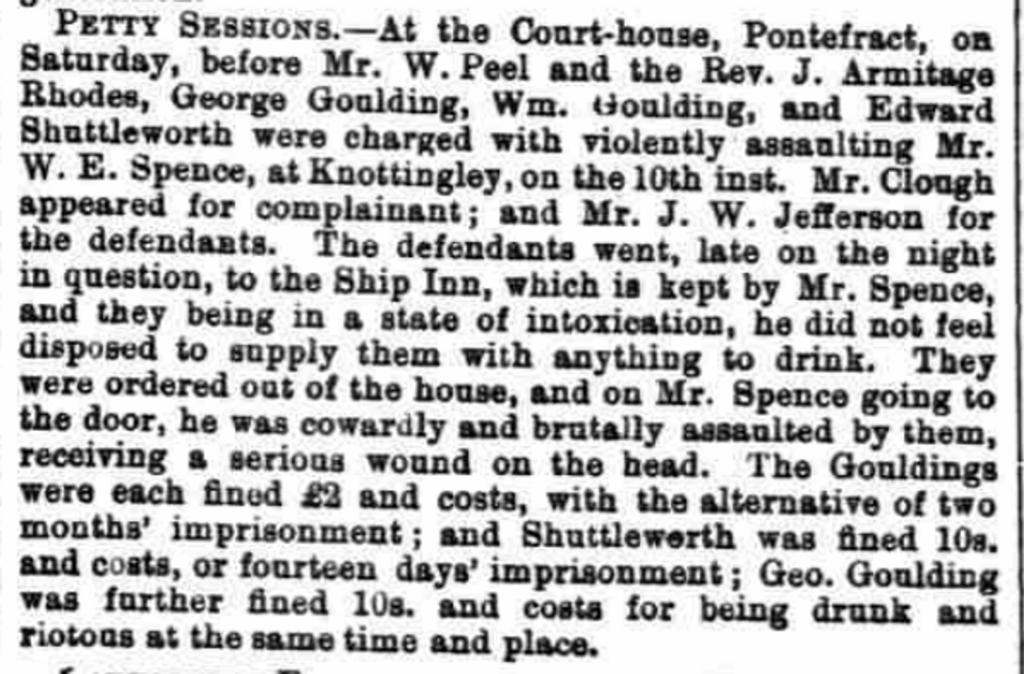
On another occasion, in 1868, William refused to serve 3 very drunk men, for which he was replayed with a beating. William received head injuries, the 3 a fine and/or prison sentence.
Which makes it all the more ironic, possibly even unjust, what happened next.
From 1870 proposals appeared to cut the number of public houses by licence limitation, increased licence duties and restrictions on opening hours. Such measures formed part of the Intoxicating Liquors Bill of 1872. The brewers needed to adopt a more responsible attitude to the problem of drunkenness as a means of countering the growing criticism against them.
Thus, when William not only allowed drunkenness in the Ship Inn in the autumn of 1875 but was prosecuted for being drunk himself, he was instantly dismissed by George Carter, from the brewery despite having been a tenant for fourteen years.
In the 1881 census he therefore described himself as a retired publican, even though only 51 years old, and in our great grandfather John’s marriage register in 1879, William was described as a Gentleman.
Accomodation was a little more difficult, since they’d lived at the Inn for the past 14 years. It seems, however, that they left on froendly terms, since their address remained 25 The Island, The Rowcroft Buildings, Pickhill Garth and Ship Lane in subsequent censuses – all of which accurately and narrowly describe the location of the Ship Inn, or perhaps in this case, one of the 4 cottages adjacent to the Ship Inn.
William’s wife Elizabeth died in 1900, aged 67. William, clearly not someone who liked to live alone, married again later that year, to Hannah Kenyon, also a widow from her first husband, Barker Drury. Sadly, this marriage lasted only 3 years until Hannah died.
Again, William wasted little time, marrying for a 3rd time a year later, to another widow, Sarah Riley nee Poppleton. This marriage saw William out for the last 9 years of his life. He had an eventful 83 years of life.
I’ve obtained a copy of his will from the probate office. It was made the year after marrying Sarah, his 3rd wife. In it, his estate is to be held in trust for the benefit of Sarah, and on her death of remarrying, it would be shared amongst his children or their children. I’m not sure whether our great grandfather John Spence ever received a share of the £531 estate. I’ve been unable to trace Sarah’s death either.